AI Application for Geoprofessionals
AGS VIC Panel Discussion
AGS VIC chapter is pleased to announce the Panel Discussion on AI application for geoprofessionals.
The potential application and experience of using AI will be discussed by the panel. The event aims to spark conversation, identify the risks and opportunities of this ever-growing technology.
There will be an opportunity to ask questions on the night of the event.
About the panellists

Ramtin Tajeddin Service Line Leader – Geotechnical/Senior Technical Director – Geotechnical, GHD
Ramtin Tajeddin is a Senior Technical Director, with 30 years’ experience in leading geotechnical design. His special interest is the implementation of Risk and Reliability‑Based Design, bringing rigor, transparency, and performance assurance to decisions. Ramtin serves as a technical advisor to state departments and authorities, helping shape resilient infrastructure through innovative geotechnical practices.
As the Service Line Leader for geotechnical engineering at GHD, Ramtin drives integrated solutions across service lines, standardising methods, and tools to streamline geotechnical delivery. He focuses on workflow harmonisation and technology alignment to embed innovation at scale, ensuring projects benefit from consistent, high-quality practices. As a part of Delivery Transformation strategy, by leveraging AI, machine learning, and automation, Ramtin’s focus is on turning cutting-edge ideas into repeatable, reliable outcomes, enabling smarter decisions and enhanced efficiency across complex geotechnical projects.

Negin Yousefpour Senior Lecturer, Melbourne University; Founder, Data-driven & Computational Geotechnics Research Group
Dr Negin Yousefpour is a senior lecturer in the Infrastructure Engineering Department and founder/director of Data-Driven and Computational Geotechnics research group at the University of Melbourne. She was the recipient of Doreen Thomas Fellowship in 2020 and several other government and industry research funding and awards. Her research focuses on AI/ML applications in geotechnics, geohazards and geo-failure prediction and early warning, reliability-based/probabilistic methods for site characterisation and foundation design, and soil-structure interaction analysis under extreme events.
Negin’s research is inspired by more than 10 years industry experience worldwide (mainly with Arup), involving high-profile projects in US/Canada, UK, Australia, and Europe such as Texas High-Speed Rail, Panama Bridge, White Rose Oil Field, Melbourne Metro, Regional Rail-Revival and Level-Crossing Removal.
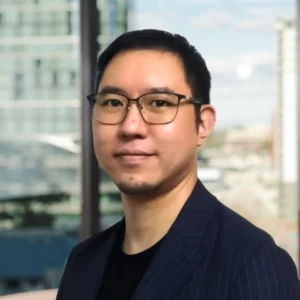
Wai Leung Ng Associate Geotechnical Engineer, Tetra Tech Coffey
Wai Leung Ng is an Associate Geotechnical Engineer at Tetra Tech Coffey with over twenty years of experience in civil and geotechnical engineering across Hong Kong and Australia. His expertise includes foundation design, deep excavations, slope engineering and landslide investigations. Having worked with consultants, contractors and the Geotechnical Engineering Office of the Hong Kong Government, he brings a well-rounded understanding of the priorities across the industry. WaiLeung is also passionate about AI and engineering automation, with a focus on developing tools that streamline workflows and enhance project delivery.

Philip Tsang Design Coordinator – Tunnels, Suburban Connect
Philip Tsang is a Tunnel/ Geotechnical Engineer, who works across a range of geotechnical and tunnelling projects with exposure to many facets including deep excavation, geotechnical interpretation, segmental lining and cross passage designs. Philip has experience using numerical modelling for a number of multidisciplinary infrastructure projects including PLAXIS 2D & 3D, Strand7 and Rocscience packages. Philip has a keen interest in innovating, challenging business as usual and finding new ways in design practice. He developed automation tools using Python to boost the efficiency of the current workflow for geotechnical and tunnelling designs. Philip also actively writes blog posts to promote automation with Python to the wider engineering community.
Questions
- What are the differences between academic advancement in ML and AI, and implementation of them in industry by practitioners? What are the roadblocks for implementation?
- What is the trend of changes in the number and competencies required in geotechnical engineering due to AI?
- How necessary is big data in AU and NZ in implementation of AI and ML?
- What should be the course to get it started.
- In your current role, where does AI actually touch your day-to-day geotechnical work today?
- What was the first task you trusted AI with in geotechnical practice, and what made you comfortable doing so?
- Do you see AI primarily as a productivity tool, a decision-support tool, or something closer to a junior engineer—and why?
- How are you using AI with subsurface data—logs, lab results, CPTs, monitoring data—and what works well versus poorly?
- Have you integrated AI into any repeatable workflows or templates (e.g. report drafting, risk registers, scope generation), can you give us some example?
- Can AI meaningfully assist with engineering judgement, or is it still limited to supporting tasks around it?
- Where do you personally draw the line between AI assistance and engineering responsibility?
- How do you validate or verify AI-generated outputs before relying on them professionally?
- Do you think current professional standards, QA systems, and insurances are adequate for AI-assisted geotechnical work?
- If an AI-assisted decision contributes to a failure, where does accountability realistically sit?
- What skills will define a strong geotechnical engineer in 5–10 years in an AI-enabled industry?
- Does AI raise the floor, lower the ceiling, or both, for junior geotechnical engineers?
- What is one AI capability you expect to materially change geotechnical practice in the next 3–5 years?
- What advice would you give to a geotechnical engineer who is sceptical of AI but feels pressure to adopt it?
- Are we training the next generation of geotechnical engineers—or quietly deskilling them?
- What is the role of the industry bodies, AGS EA etc in preparing the application of AI
- If AI consistently outperforms average engineers in certain tasks, is it unethical not to use it?
- Is the biggest AI risk technical failure—or misaligned commercial incentives?
Correction
Ramtin Tajeddin, correction: to question regarding the liability of autonomous vehicle (AV) companies.
“My previous remarks suggested that these entities consistently evade responsibility by shifting blame to human operators. While this was a prevalent concern during the experimental and “supervised” phases of 2023, the regulatory landscape has evolved significantly as of 2026.
As we have moved into full Level 4 commercial deployment, the following changes have rendered my previous claim outdated:
- Statutory Responsibility: In major markets like California and the UK (under the Automated Vehicles Act 2024), the law now identifies the manufacturing or operating company as the legal “driver” or “operator” when the autonomous system is engaged. This removes the legal burden of the driving task from the human occupant.
- Strict Accountability: New frameworks, such as the UK’s “Authorised Self-Driving Entity” (ASDE) model, make the corporate entity responsible for traffic infractions and collisions caused by the software, ensuring that passengers are not held liable for the vehicle’s technical decisions.
- Insurance and Enforcement: Regulators now mandate high-level liability coverage (often $5M+) for driverless fleets, and as of 2026, law enforcement in several jurisdictions can now issue “notices of noncompliance” directly to manufacturers for traffic violations.
When a human is not driving, a collision is often treated as a “product failure” rather than a “driving error.” This brings the case under the umbrella of product liability law. Victims can argue that the vehicle’s software or hardware was “defective” in its design or manufacturing. For example, if a LiDAR sensor fails to detect a pedestrian in a crosswalk due to a known software bug, the manufacturer can be held strictly liable, meaning the plaintiff does not necessarily have to prove that the company was “careless,” only that the product was dangerous and failed during normal use.
I believe it is important for the published record to reflect that while companies still utilise traditional legal defences (such as comparative negligence regarding third parties), they can no longer legally deflect the primary responsibility for the “driving task” to the human passenger in a fully autonomous vehicle.”
To watch the recording of this panel, please login.
Engineers Australia members participating in AGS technical sessions can record attendance on their personal CPD logs. Members should refer to Engineers Australia CPD policy for details on CPD types, requirements and auditing guidelines.