It is with great sadness that we share news of the passing today of inaugural AGS Life Member, Dr William (Bill) Bamford following a recent decline in his health.
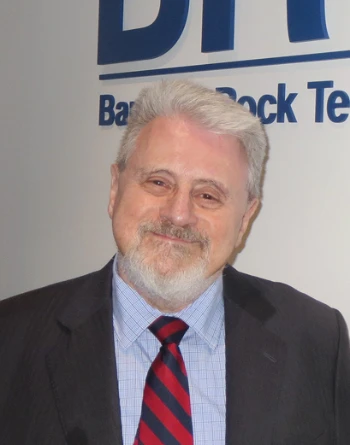
Born in 1936 in Tahiti, Bill spent his childhood in New Zealand and Norfolk Island before moving to Sydney in 1950 where he attended high school. He commenced his civil engineering studies part time at Sydney Technical College in 1953 while working as a cadet engineer at Woollahra Council. He progressed to fulltime study at UNSW in 1955 with National Service in the RAAF at Laverton Base in 1956-57. He obtained his Bachelor of Engineering in Applied Geology from the University of NSW in 1958. He spent a summer at the Snowy Mountains Hydroelectric Authority as a vacation student in 1957 and started fulltime as a graduate in 1958 under the direction of David Stapledon. He worked on the Tumut 1 underground power station and its tailrace tunnel, the Geehi Dam and Murray 1 Underground Power Station investigations, and was resident geologist on the Murrumbidgee-Eucumbene Tunnel. It was whist drilling deep exploratory diamond drill holes on Broken Back Spur that he became involved in heat-flow investigations being carried out by Professor John Jaeger, a relationship that would later influence the (future) Australian Geomechanics Society award bearing Professor Jaeger’s name.
In 1960 Bill accepted a job offer from John Neilson to work at the Geological Survey of Victoria and remained there until 1964. During this time he was involved in many projects around the state including proving the brown coal resource at Anglesea which fuelled the Alcoa power station that supplied Point Henry smelter. Importantly, he commenced geotechnical investigations for the Melbourne Underground Rail Loop, subsequently transferring to the Victorian Railways Construction Board 1965-67, where he led the geotechnical investigations for the project that would change public transport through the city.
In 1967 he was appointed to the position of Lecturer in Rock Mechanics in the Mining Department at the University of Melbourne. This was the first Lecturer in Rock Mechanics to be appointed in Australia, recognition of the advances in tunnelling being made in Australia over that period. His inaugural student cohort included Jim Enever, Jim Askew and Leigh Clifford. He continued to supervise post-graduates until his final PhD student, Frank Lai, in 2011. While developing the course structure, Professor Jaeger invited Bill to spend some time with him at the Australian National University to discuss teaching and research in the field of rock mechanics. During this visit, Bill witnessed high pressure triaxial testing of Wombeyan Marble shearing along a distinctive 30-degree failure plane. Twelve years later Bill would immortalise Professor Jaegar’s tests, when he was asked to prepare an award recognising contributions of the highest order over a lifetime commitment to the geotechnical profession in Australia. Mounted on white marble, the AGS Jaegar Award adopts the shape of the triaxial samples Bill had observed in the ANU laboratory; interestingly, he was unable to reliably replicate the 30-degree surface because the chamfered point tended to break off under slight pressure; as a result the award contains a plane cut at 45 degrees instead. Bill also arranged production of mementos, cut from granite drill core, for presenters at Victorian AGS meetings, affectionately known as ‘Bamfords’.
Bill was the AusIMM representative on the National Committee of the AGS from the time it was formed in 1971 until he became National Chair of the AGS in 1975. In 1970 Bill had organised a symposium on tunnelling as an adjunct event to the AusIMM conference in Melbourne; this was the precursor to the Australian Underground Construction and Tunnelling Association (AUCTA), formed in 1972 and subsequently the Australian Tunnelling Society (ATS). At that time AUCTA remained under the auspices of the AGS and so Bill assumed the role of AUCTA Chair as well. He continued to be a member of the National Committee of the AGS from 1971 until 1987 and was a member of the Victoria Chapter committee from 1968 until 2012. During this time he served as Victoria chairman for 3 terms; initially in the mid-70s, again in the mid-80s, and once more in the mid-90s. He also served on the Australian Tunnelling Society National Committee from 1975 until 2002, and on the Victorian Chapter Committee from 2011 until 2015. He was also involved in the International Tunnelling Association (ITA), which included being on the organising committee for the 1987 World Tunnel Congress in Melbourne.
At the completion of his term as AGS National Chairman in 1979, Bill was nominated to be the ISRM Australasian regional Vice-President 1979 to 1987. He contributed to the Commission on Testing Methods, the Commission on the Teaching of Rock Mechanics, and was the President of the Commission on Swelling Rocks and the Commission on Rock Boreability Cuttability & Drillability. Under his tenure Australia hosted the 1983 ISRM Congress, for which he was the organising chairman.
Bill was awarded his PhD for his thesis on ‘Geotechnical Studies for Machine Tunnelling’ at the University of Melbourne in 1983. In 1987 he accepted the position of Director of First-Year Engineering Studies. He was subsequently appointed Associate Dean – Academic for the School of Engineering, a role he maintained alongside a full undergraduate teaching load and postgraduate supervision. He was also generating significant income for the School of Engineering by consulting externally through his rock mechanics laboratory.
By 1996 his commitments to the university started to reduce. As a Principal Fellow and Associate Professor, Bill continued with a partial teaching load, and importantly maintained operation of the rock mechanics laboratory for external consulting.
In 1997 the AGS proposed a joint ISRM, IAEG, and ISSMFE event; GeoEng 2000 – an International Conference on Geotechnical and Geological Engineering, to be held in Melbourne Australia in November 2000. Bill was part of the organizing committee who successfully pitched the event to the 3 international societies, after which he assumed responsibility for organizing the “Underground Works” stream.
Bill was appointed a Senior Principal at Coffey in 2011, moving the lab from the University of Melbourne 44 years after he set it up on campus. Bamford Rock Testing Services (BRTS) was established in 2014, and continues to provide specialist rock testing to clients from around Australia and the world. Bill remained active in overseeing and reviewing test results to the end.
As a final accolade, Bill was awarded the Allen Neyland Tunnelling Achievement Award for 2025, something that pleased him greatly although he regretted not being able to receive it in person.
Over the years Bill has taught many students, supported innumerable societies and committees, established many dedicated clients, and earned many friends. Among other activities, he was also a talented dancer and performed with a number of groups at Hamer Hall as well as the Lygon St Festa. With access to his consulting funds, he arranged for a sprung floor and full length mirrors to be installed in the Frank Tate Building in the University where dance rehearsals could take place.
Bill is survived by his partner Jenny, son David and daughter Barbara.
It has been a privilege to have known Bill as a lecturer, colleague and friend; our careers wouldn’t have been the same without him.
Vale Bill Bamford.