Woven geotextile for pavement sub grade separation/stabilisation – Jugiong Bypass, Hume Highway
Introduction
The Roads and Traffic Authority in NSW has for a number of years been involved in an extensive upgrading program for the Hume Highway. The Jugiong Bypass, 56 kms south ofYass is one of the sections included in the upgrade, intended ultimately to provide dual carriageway for the Hume’s entire length.
Technical Considerations
One problem that is typical of all road construction projects is areas of poor subgrade that are unsuitable for pavement construction.
The advent of geotextiles has solved a majority of problems. Until very recently non woven geotextiles have had an exclusive hold in this field of expertise. Non-wovens are strong and permeable but where high strengths are required, a higher mass per square metre is required. This increases cost.
Vicroads, as part of their similar Hume Highway upgrading, have for a few years accepted the use of woven geotextiles and consequently included wovens in specifications.
Wovens have the advantage of very high strengths and burst strength, but at lower mass per square metre to achieve these higher values. Consequently, Vicroads have used upwards of 200,000 m2 of woven geotextiles in projects such as the Kyneton, Ballarat and Wangaratta Bypass and the Princes Highway near Moe.
The Snowy Mountains Engineering Corporation, acting on behalf of the RTA, required a ½ kilometre section of the Jugiong Bypass to be laid with a geotextile to improve the subgrade strength. The prevailing material was a silty soil type and exhibited very poor strength. SMEC required a high strength material at a competitive price.
Geosynthetic Selection
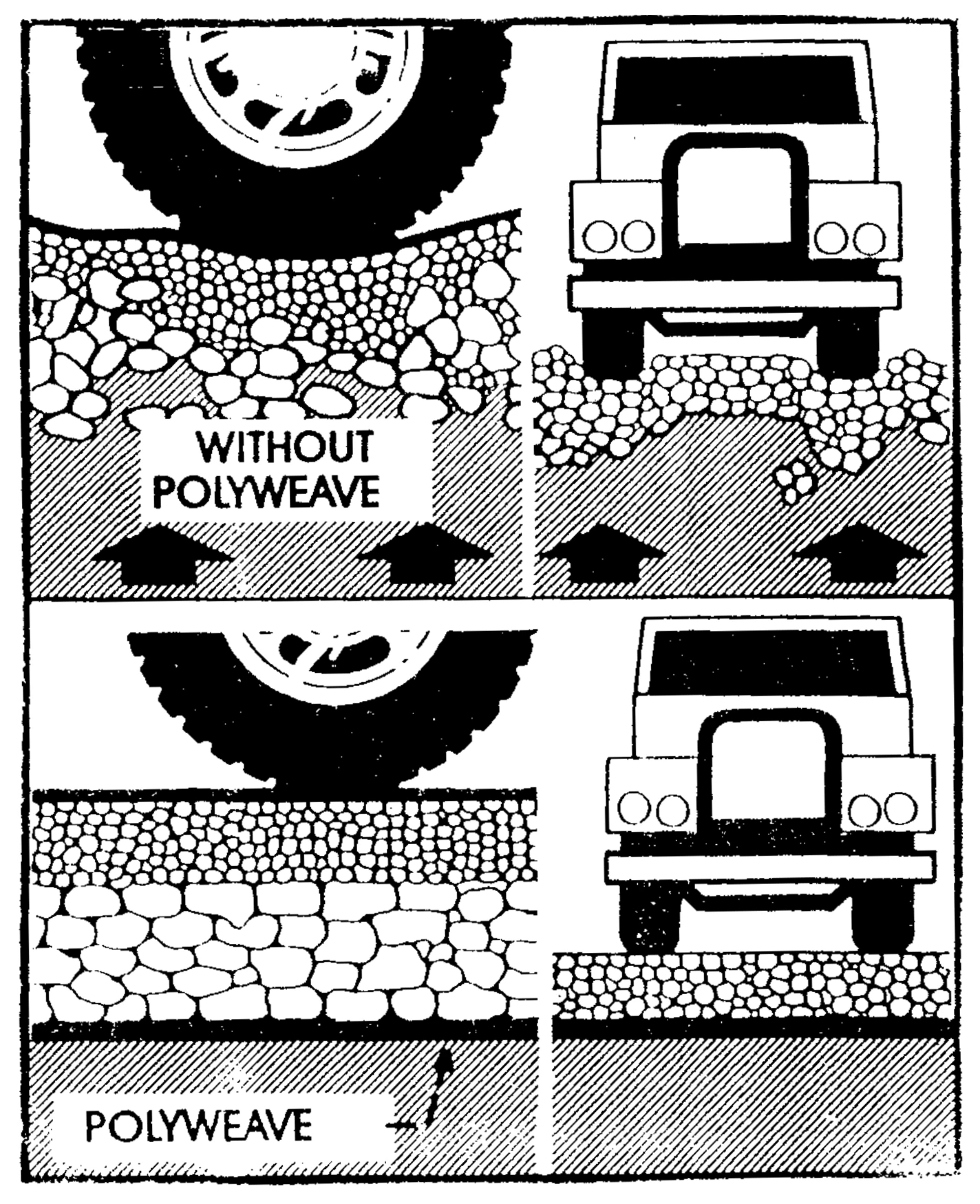
Polyweave HR (heavy road) was selected. The selection was based on the:
- High tensile strength to mass ratio offered by Polyweave.
- High burst strength. The subgrade material was prevented from punching through and contaminating the pavement base materials.
- Working platform. Once the fabric is laid an effective working platform would allow the construction process to proceed productively.
- Cost. Polyweave offers superior cost advantages when compared to non-woven geotextiles which offer similar tensile strength and separation properties.
Construction
Thiess Constructors Pty. Ltd. have been awarded the contract worth some $80 million. The contract includes the construction of 13km of dual carriage way and includes five bridges. The project is scheduled to be completed mid 1995.
At this stage, some 32,000 sq.m of Polyweave HR have been installed over poor CBR subgrade areas.
Conclusion
Simply put, Geotextiles should be selected on the basis of function and application. Consideration to geotextile type, properties and construction constraints will significantly affect the geotextile selection and consequently the economics of the solution.
The utilisation of Polyweave HR as the pavement separation and stabilisation geotextile has allowed the contractor to continue with their programme and not be delayed with poor subgrade conditions.
Polyweave offer a range of low cost filtration, separation and stabilisation geotextiles to suit most applications and are available through the Geolab Group throughout Australia.
References
- “Designing for Soil Reinforcement” Exxon Chemical Geopolymers Ltd: Design Service, 2nd Edition 1992.
- “Guide to Geotextiles” Austroads Report 1991.