Transverse transmissivity testing of geocomposites linear flow method
Project Description
In 1988, the State Electricity Commission of Victoria proposed to use geocomposite (composite geotextile) material for a batter stabilisation project at the Township Field of its Yallourn Open Cut brown coal mine. It was proposed that a geocomposite be sandwiched between the coal batter and a low permeability earthfill, toe surcharge, to provide batter drainage. The required flow capacity was estimated to be 1.0 litre/min/metre width, under surcharge loadings of up to 550 kPa.
Geocomposites consist of a high permeability core, with a covering of geofabric on one, or both, sides to minimise the ingress of and blocking by, fine grained materials.
The available published data and the manufacturers specifications for in-plane flow of geocomposites were, however, generally quoted for much lower confining pressures. A specific testing procedure was, therefore, required to compare the variety of materials available and to ascertain whether the design flow rate could be met by any of these products.
Test Method Considerations
A test method was required in which a high surcharge loading could be applied while modelling the field conditions.
One side of the geocomposite would be placed against the 23m high sloping coal face, which is relatively hard, with an uneven surface and is unlikely to deform significantly, or mould into the voids of rigid core geocomposites. The other side of the geocomposite would be in contact with a variety of soils which would most likely deform and remould into any openings or depressions in the geocomposite.
Adoption of Testing Method
In 1988, Standards Australia did not have a procedure for hydraulic transmissivity testing of geocomposites. However, a draft standard (Now AS3706.10.1 – 1991) “Determination of Transmissivity – Radial Method” was available and this method was initially used in an attempt to determine the transmissivity of some of the geocomposites. This apparatus was not capable of testing materials with a preferred flow direction and it was difficult to obtain consistent and repeatable results.
As a consequence an alternative method (Linear Flow Test) was developed to measure transmissivity. This method, described later in detail, is a linear flow method and has some significant advantages over the radial flow apparatus
The testing procedure adopted was based on the method outlined by Beck (1988), which, after some refinement, gave consistent and repeatable results. The test procedure is detailed in the following sections.
Linear Flow Test
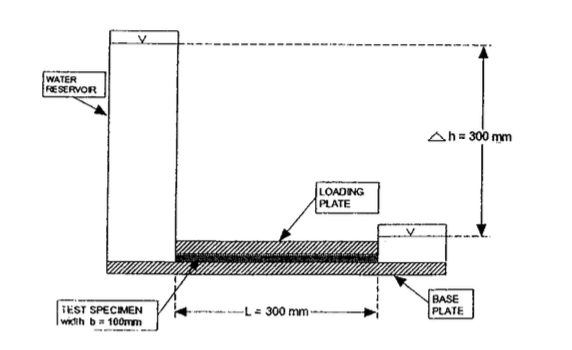
The constant head linear flow apparatus,constructed for this project, consists essentially of two parallel steel plates which are used to transfer, evenly, the load applied by a triaxial frame to the geocomposite sample. It utilises two water reservoirs to maintain a constant hydraulic head and a rubber membrane to encase the sample forming a water tight system. The apparatus is drawn schematically in Figure 1 below:
The flow rate is expressed in terms of discharge per unit width:
where
= hydraulic transmissivity (m²/sec) for water temperature of 20˚C
q = volume flow rate (m²/sec)
= width of sample tested (m)
= length of sample tested (m)
= pressure head differential (m)
= (m/m)
Test Procedure
A 300mm long by 100mm wide geocomposite sample inside a rubber membrane is placed into the apparatus. The design load is applied through the top plate and, when required, load application is simulated, on rigid core samples, using a clay or sand layer inserted between the rubber membrane and the steel plates. The geocomposite sample is then consolidated or compressed under the test load for 16 hours prior to application of the required hydraulic gradient and measurement of the resulting flow rate.
Tap water was used in the initial series of tests. It was however evident that the measured flow rate reduced significantly with time. Inspection of the samples, during testing, indicated gradual formation of air bubbles on and within the geocomposite which were progressively blocking the flow paths in the test specimen.
Studies by Halse et al (1988) indicated that dissolved oxygen and air bubbles had a marked effect on measured flow rates, in line with our observations, and suggested the use of de-aired water to overcome the problem. De-aired water was used in all subsequent testing and although water in the reservoirs could not easily be isolated from air, it was apparent that air bubble formation was significantly reduced.
Performance
Tests on geocomposite materials, using de-aired water, produced flow rates up to three times greater than tests using tap water. The flow rate remained relatively stable during the tests which were generally carried out over an 8 hour period.
A series of 10 repeat tests were carried out on samples of experimental geocomposite material Drainmat Type 8 using de-aired water under confining pressures of 300 kPa and 550 kPa. The experimental sample was made from 2603 g/m² polypropylene staple fibre core covered with 250 g/m² polyester staple fibre needle punched fabric on one side only. The results are summarised below:
| Confining pressure (kPa) | Flow rate (litre/min/metre width) | |
|---|---|---|
| Mean | Coefficient of cariation | |
| 300 550 | 2.87 1.20 | 10.7% 16.2% |
This series of tests indicate a high degree of repeatability using the test method and the linear flow test apparatus.
Conclusions
The linear flow apparatus, developed for testing of the in-plane flow capacity of geocomposites, has proved a flexible tool capable of producing results with a high degree of repeatability.
Its capability to test the materials with a preferred flow direction gives it an advantage over the radial flow apparatus. The use of de-aired water in the test reduced interference to flow by air bubbles and ensured repeatability ofresults which was not possible with tap water. This method was successfully used to select suitable geocomposite materials for the Yallourn Open Cut batter stabilisation project.
References
AS3706.10.1 (1991). “Determination of Transmissivity – Radial Method”, Standards Australia AS3706.10.1, November 1991.
Beck, D.E. (1988). “Testing and Comparing Geo-composite Drainage Products”, Geotechnical Fabric Report, July/August 1988.
Halse, Y.R., Lord, A.E. Jr. and Koerner, R.M. (1988). “Effect of Dissolved Oxygen (and Bubbles) on the measured Permittivity of Geotextiles”, Technical Note, Geotechnical Testing Journal, ASTM 1988.