Piezocone penetrometer testing and dimensionaless excess pore pressure
The use of the piezocone (CPTU) probe has become increasingly popular and is currently one of the most widely used in situ investigation devices. The addition of a pore pressure measuring system to the cone penetration test (CPT) provides much more information about the in situ soil and thus enables a much clearer picture of the subsurface soil conditions to be obtained.
The pore pressure measured during a CPTU test in a saturated soil consists of two principal components. Firstly, the hydrostatic pore pressure, u0, and secondly a component, 𝛥U, is intended to provide a better indication of the in situ state of the soil than does the raw excess pore pressure, 𝛥u, generally termed the excess pore pressure, that represents the change in water pressure caused by penetration of the instrument. This excess pore pressure is a function of the soil permeability and drainage, and therefore its grain size, as well as the mechanical characteristics of the soil, in particular, the density and dilatancy characteristics. Interpretation of excess pore water pressure is complicated by the fact that it is also affected by the drainage conditions, soil consolidation behaviour, and the rate of loading during the test.
Berrill et al. (1992) proposed a simple non-dimensional form for excess pore pressure in an attempt to minimise the effect of differing soil drainage conditions and rate of loading. With these factors eliminated the resulting dimensionless excess pore pressure, 𝛥U, is intended to provide a better indication of the in situ state of the soil than does the raw excess pore pressure, 𝛥u, and thus enable better interpretation of piezocone results. The dimensionless form of excess pore pressure is given by:
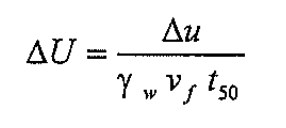
In this expression, 𝛥u is the raw excess pore pressure, 𝛾w, is the unit weight of water, vf is the penetration rate, and t50 is the time for half of the excess pore pressure to disipate.
The initial intention of this project was to test this expression for the normalisation of excess pore pressure. However the investigation became sidetracked into a technical problem which arose from a combination of the modification of the in situ state and the clogging of the piezocone filter element.