Geosynthetics in Australia – Past and Future
Geotextiles and Related Products
Definitions
The term geotextile first appeared at the 1977 International Conference on the Use of Fabrics in Geotechnics held in Paris. Today, the Australian Standard defines geotextile as “any permeable textile material used with foundations, soil, rock, earth, or any other geotechnical engineering-related material as an integral part of a project”. In Australia, it is not uncommon to hear the term “geofabric” instead of geotextile, although it is associated with a trade name.
A geomembrane constitutes a very low permeability membrane, usually a liner or barrier, used with any geotechnical engineering-related material for control of fluid migration in a project (AS 3704-1990).
A mesh or net-like open structure with openings or pores much larger than the bulk dimensions of its components made by superposition of interlacing, punching, or bonding of yams, filaments, strips, etc. is called a geogrid (AS 3704-1990).
Geotextiles, geomembranes and geogrids are the most important members of the family of geosynthetics, which today includes a number of additional geo-products, such as geocomposites, geonets, geopipes, and more.
The advent of geosynthetics has given rise to a rediscovery of engineering uses for natural fibres. Geojute is such a product which has growing use in erosion control. Considering that in the 1930’s Australian road engineers trialed wool for subgrade reinforcement, geowool would be another (Anonymous, 1933)
The Role of Geosynthetics
Geotextiles were the first geosynthetics to find wide application in geotechnical engineering. The reason for this is partly due to the aggressive marketing efforts of the manufacturers and a willingness of engineers to experiment with these new products in an effort to reduce project costs and construction time. For example, geotextiles were found suitable to replace expensive sand separation and filtration layers; in addition they provided the benefit of tensile reinforcement. It is of interest to note that a typical non-woven fabric, the most commonly used product, has a permeability similar to sand; it is, however, lighter, more uniform, and easier to handle and install.
Geomembranes have rapidly gained in importance because of environmental concerns related to ground water pollution. They either replace or complement traditional clay liners for landfills, liquid storage, or heap leaching in mining.
However, geosynthetics not only replace traditional construction materials, but they may make entirely new designs possible. Manufacturers have proven to be able to respond quickly to demands by innovative engineers, coming up with specialist products such as geogrids, geocomposite drains, geosynthetic clay liners and more.
Total Market Growth
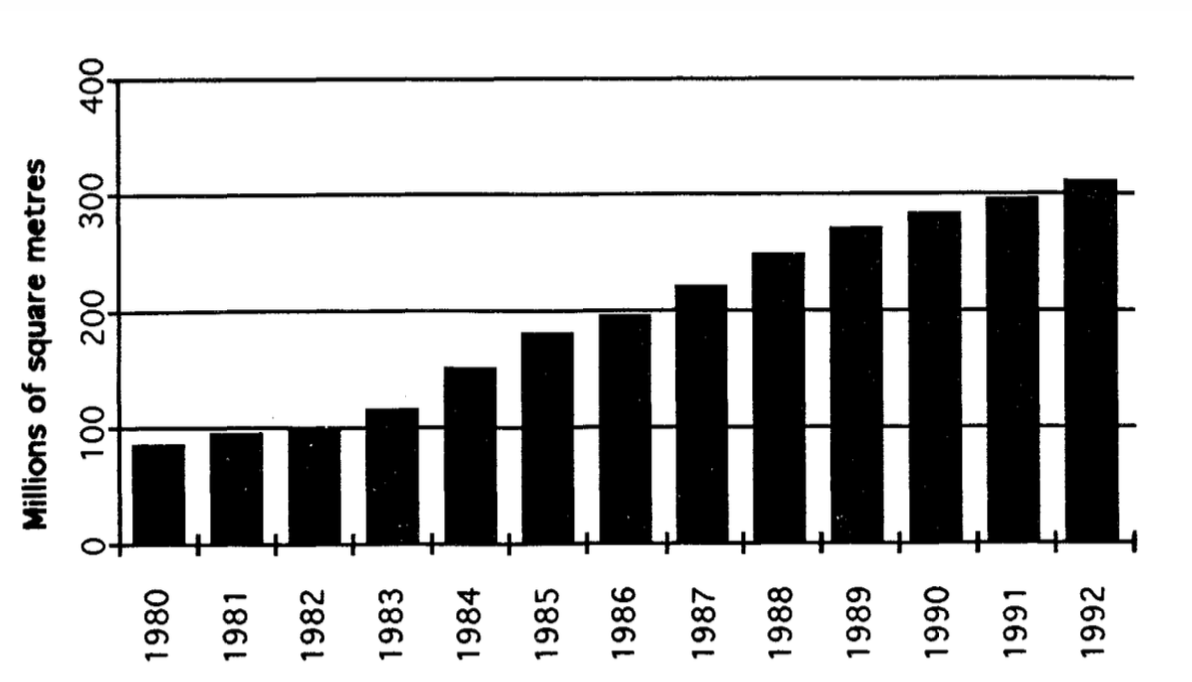
The growth of the geotextile market is illustrated in Fig. 1. The data is for the U.S. and Canada, which probably represent about half of the world market. Between 1983 and 1988 the annual growth exceeded 15%. Since then the geotextile market has settled down, but despite the recession the industry is still expected to increase production by some 5% in 1993.
No comparable figures are available for Australia, but because the market here is not as mature as in North America, it is likely that its current growth rate is more than 5%.
In North America, about 70% of the geotextiles are non-woven materials. In Australia, the market is dominated by the Bidim range of geotextiles, probably to the extent of 75 to 80%. Bidim is a non-woven polyester fabric produced locally by Geofabrics Australasia Pty. Ltd. since 1987.
Although the growth of the geotextile market in the U.S. has diminished, installations of geomembrane lining systems (including geotextiles and other geosynthetic products) are increasing dramatically, more than 15% per annum. In 1992, in excess of 50 million square metres oflining systems were placed. This market is essentially regulatory driven, principally by the U.S. Environmental Protection Agency.
In Australia, geomembranes have found use as liners for water and liquid waste storage, landfills and heap leaching pads for mining, and as floating covers for reservoirs and waste ponds. Talevski (1990) estimated that prior to 1984 only a total of 0.2 Mill. m² of geomembrane were used, predominantly made of Hypalon and PVC. For 1990, annual consumption was estimated to be around 0.7 Mill. m². Industry experts believe that by 1992 this figure rose to 1.4 Mill. m² per annum. More than 70% of the geomembranes currently being installed are made of HDPE (high density polyethylene).
Another product line still showing above average growth are geogrids, particularly in the reinforced soil wall application.
A historical perspective
Global Benchmarks
As pointed out by Giroud (1986) the idea of combining soils with various reinforcing materials such as wood, bamboo and straw already emerged in the ancient civilisations of the Chinese, Babylonians and Romans. In modern times natural materials such as jute and cotton fabrics were used in civil engineering applications long before the advent of synthetics.
Geotechnical use of synthetic fabrics in sheet form started in the late 1950’s, apparently more or less simultaneously in Europe, the U.S. and Japan (Giroud 1986). Initially the products used were woven fabrics and occasionally PVC membranes. Real growth in the applications of fabrics in ground engineering came with the mass production of non-woven fabrics, particularly those with continuous filaments, bonded together by needle punching or heat bonding.
The 1977 Paris conference and subsequent international conferences became benchmarks in the history of geosynthetics:
- 1977 International Conference on the Use of Fabrics in Geotechnics, Paris.
- 1982 The Second International Conference on Geotextiles, Las Vegas.
- 1985 The Third International Conference on Geotextiles, Vienna.
- 1990 The Fourth International Conference on Geotextiles, Geomembranes and Related Products, The Hague.
- 1994 The Fifth International Conference on Geotextiles, Geomembranes and Related Products, Singapore (in preparation)
These international forums were soon complemented by regional seminars and conferences.
The 1977 conference was sponsored by the Ecole Nationale des Ponts et Chaussees, the oldest school of civil engineering in the world. The terms “geotextile” and “geomembranes” first appeared there, in a paper by Giroud and Perfetti (1977), although a clear distinction between these two types of geosynthetics was only adopted later. Contributions to this conference clearly demonstrated that fabrics can provide filtration, drainage and reinforcement and are beneficial if placed at the interface between different soil layers.
Leading up to the time of the Las Vegas conference in 1982, geotextiles became recognised as construction materials by a wider engineering community. Index tests defining the properties relevant for geotechnical application came under scrutiny and were further improved. Developments were essentially driven by manufacturers, with engineers concentrating on applications where geosynthetics replaced more conventional materials and mostly only served a temporary role. Costs were the main criterion for selection of a fabric.
Proper recognition of fabric functions allowed improved design models to emerge by the time the 1985 international conference was held in Vienna. In between the First International Conference on Geomembranes was held in Denver. The principles of design by function received even more attention when the book “Designing with Geosynthetics” by R.M. Koerner was published (1986). During the same period, the great potential of geocomposite drains was recognised.
The conference in The Hague, 1990, highlighted the need for field performance measurements in order to improve design procedures by taking into account aspects such as construction damage, abrasion, degradation and creep. The need for partial safety factors, limit state design and probabilistic approaches was recognised. While the Vienna conference focused a lot of attention on non-woven fabrics, the The Hague conference was thought to give a boost to the use of high strength wovens in embankment and dam construction. However, high strength wovens are also high cost products and have thus not experienced the same growth as other geotextiles.
At the coming conference in Singapore, 1994, it is likely that a large number of papers will concentrate on geosynthetic reinforcement, often achieved with geogrids, rather than geotextiles. Waste containment and pollution control with geosynthetics will also figure prominently.
Early Australian Efforts in Geosynthetics
Geotextiles were first imported to Australia in the late 1970’s, but specialist suppliers with technical support did not make a mark until the early 1980’s. O.G.Ingles, then with the CSIRO (see Ingles and Metcalf 1972) was the first researcher to recognise the potential of these materials in geotechnical engineering. His research initially concentrated on Membrane Encapsulated Soil Layers (MESL), a technique used to control volume change in road subgrades (Ingles and Lawson 1977). Geogrids, then called resinous meshes or nets, were subject of a paper by Yamanouchi at the CSIRO Symposium on Foundations on Interbedded Sands held in Perth in 1970.
At the pioneering 1977 Paris conference, Australian contributions came from Ingles (Ingles 1977) and Hausmann (Hausmann and Vagneron 1977).
A workshop on geotextiles was held at the Fourth Australia-New Zealand Conference on Geomechanics in Perth, in 1984. Some years before, a mini-symposium was organised by the Sydney Group of the Australian Geomechanics Society. Neither of these events produced proceedings.
The use of geotextiles in Australia was reviewed at the Vienna conference by Finn and Sadlier (1986). Geomembrane applications in Australia were the subject of a paper by Parker and Sadlier ant the Geosynthetics ’91 Conference in the U.S.
Testing Standards
Draft standards for the testing of geotextiles were first issued in Australia in 1985. This represented a very prompt response by Standards Australia to the needs of manufacturers and users of geotextiles. By 1990 a reasonably complete set of index tests became a standard (see Appendix). A first revision of a testing standard, the drop cone method for evaluating puncture resistance, was adopted in 1993.
The original SAA Committee CE/20 on Geotextiles has now been reconstituted and renamed Committee CE/20 on Geosynthetics. It will consider expanding the range of index tests (which measure the performance of geotextiles in isolation) and introducing soil/geotextile interaction tests, including soil/geosynthetic shear and filtration tests. It is likely that a subcommittee will be formed to assess the need for special tests for geomembranes.
Developing a new standard of testing, code of practice or design guideline in Australia relies largely on the voluntary efforts of individuals, government organisations and private industry. It costs time and money but helps to maintain high standards and fair competition in engineering, both leading to a more efficient use of resources. Unfortunately, funding for development work in geosynthetics seems to be drying up and Committee CE/20 will be forced to wait for the appearance of European, American or international standards and follow a policy of ‘adopt and adapt’, rather than respond directly to the problems in hand. Pioneering work such as the establishment of a Robustness index by Queensland Main Roads or the writing of a standard for geotextile reinforced seals by the Road and Traffic Authority of N.S.W. will become more difficult in an environment starved of support for research and development.
Towards rational product selection
Design by Function
The first step in the rational selection of a geosynthetic for a particular project is to recognise which functions it has to fulfil. A geosynthetic generally is to provide one or more of the following:
- Drainage
- Filtration
- Separation
- Reinforcement
- Fluid barrier (for geomembranes or impregnated geotextiles)
Additional more specialised functions may be distinguished, such as protection (stress distribution, cushioning, etc), erosion and dispersion control, screening and fencing, tensioned membrane, and more.
The second step in determining product requirements is usually to identify geosynthetic index properties relevant for the particular function. For filtration, reference will be made to permittivity and equivalent opening size in order to ensure adequate fluid flow without piping. For separation it will be a combination of strength properties, such as tensile strength and grab strength. For the reinforcement function it will be the tensile strength and ideally, going beyond a mere index test, the soil/geosynthetic friction angle.
The third step generally involves drawing on semi-empirical design criteria which link index tests to in-situ performance. For filtration, the criteria chosen could, for example, be:
(Permeability criterion)
(Retention criterion)
where is a permeability value, a representative fabric opening size and and parameters deduced from the grain size distribution.
The fourth step is to choose a suitable cost effective fabric which satisfies the design criteria.
Additional technical factors which may affect the choice of geosynthetic would be survivability (the capability to resist construction damage) and workability (related to ,the stiffness and handling characteristics). Where permanent functionality is required, durability considerations have to be included.
The publication of the Guide for Geotextiles by Austroads (1990) was a significant step towards the rational use of geotextiles in road engineering, the major area of geotextile use in Australia.
Resistance against damage due to construction procedures is measured in terms of the robustness index G, which is based on the results of the CBR plunger test and the drop cone test. This concept was developed by the Main Roads Department of Queensland.
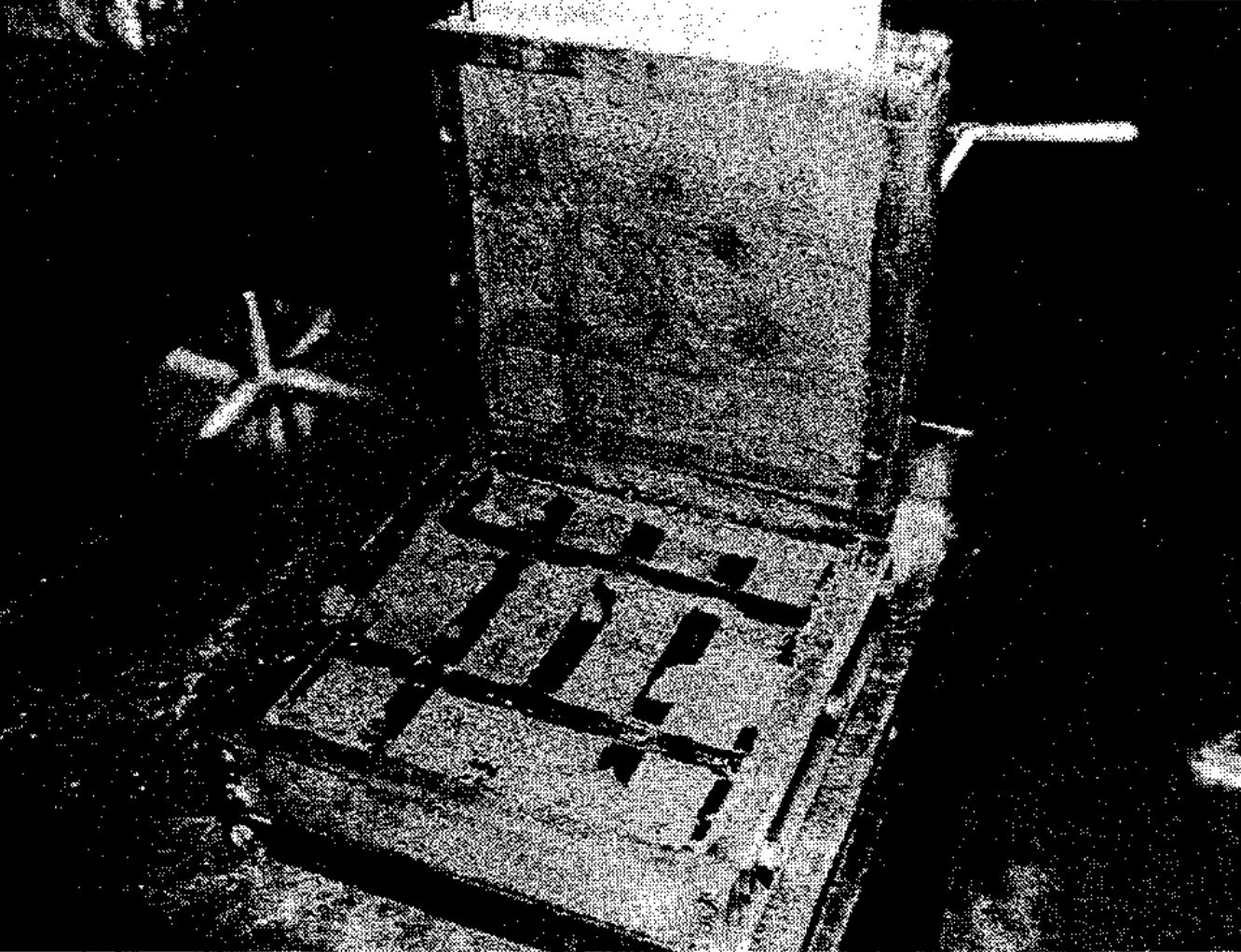
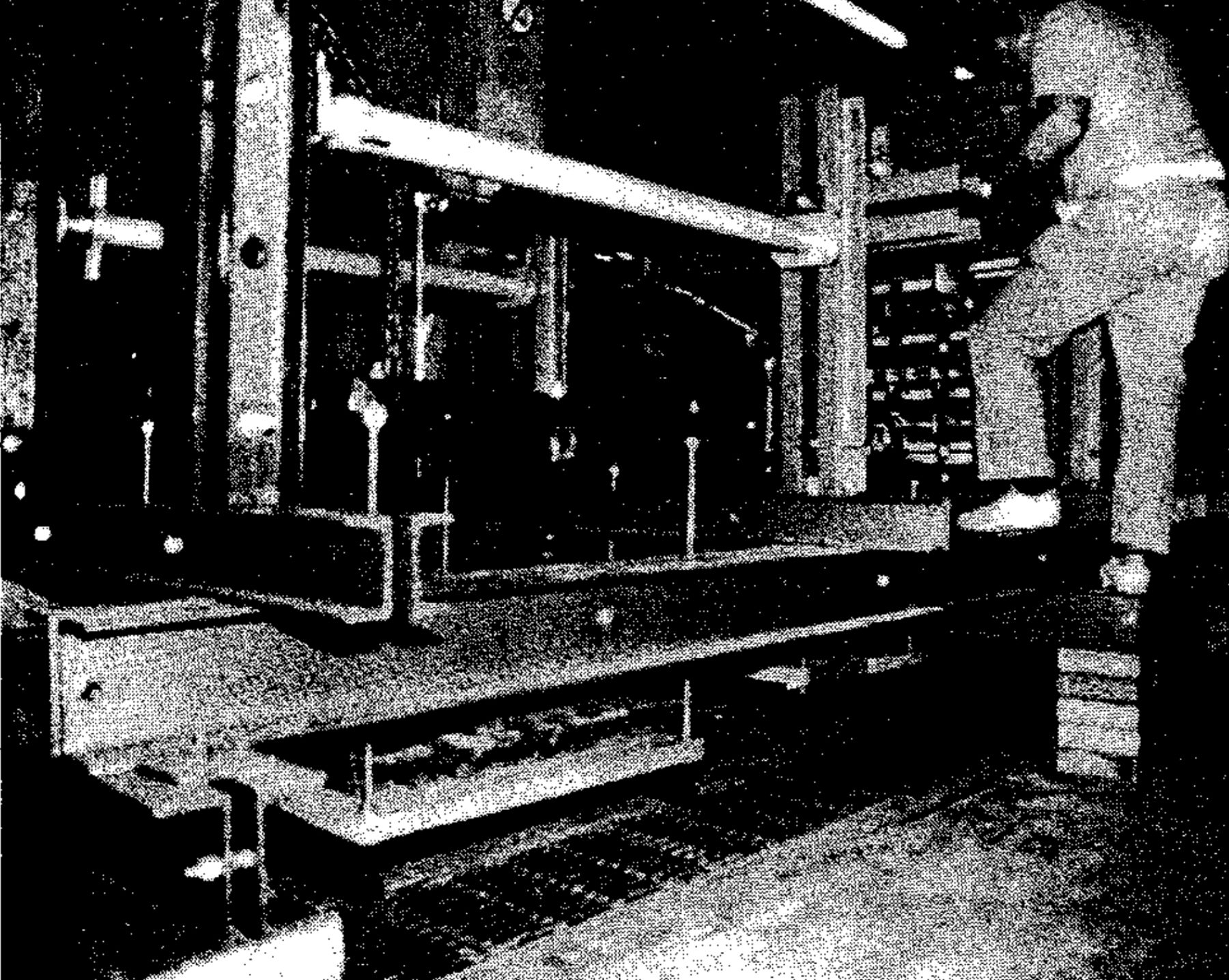
Design and analysis procedures for the reinforcement function are currently more sophisticated than for other functions, because engineers can draw on the knowledge gained in the analysis of soil structures strengthened by steel strips and meshes. However, it has become clear that differences exist in the behaviour of soil structures reinforced by very stiff steel elements as compared to relatively extensible synthetic reinforcement. Increasingly, engineers require experimental assessment of soillgeosynthetic interaction in direct shear and pullout (Photos 1 and 2) in order to obtain the stress-strain and strength parameters required for advanced methods of analysis.
Permanence of Geosynthetic Installations
Commercial production of polyester fibres began in 1949. The first polypropylene fibres became available in 1954, as did high strength polyethylene filaments (Giroud 1986).
The first application of synthetic fabrics in ground engineering was most likely in the form of sandbags – typically a very temporary form of soil containment. In many routine applications of geosynthetics today these materials are still only considered to serve a temporary purpose: Overcome construction difficulties, provide strength until consolidation increases soil strength, or give support for surface soils until vegetation improves erosion resistance.
Civil engineers who are used to think in terms of a 50, 70 or 100 year design life for structures show a legitimate concern about the permanence of geo-synthetic installation. Most synthetics are known to degrade rapidly if exposed to ultraviolet radiation but they show little if any adverse effects when buried in soil, at least for as long as they have been available.
Laboratory studies show that oxidation of polyolefins and hydrolysis of polyesters clearly affect strength and stress-strain behaviour of synthetic fabrics. As discussed by Koerner et al (1992) lifetime prediction of geotextile or geomembrane properties is difficult due to the variety of polymers involved and continuously improving additives for stabilising their properties.
Degradation of synthetics is usually assessed in terms of tensile strength. In soil reinforcement application creep and stress relaxation is equally important since it affects the deformation and thus possibly the serviceability of the structure.
Koerner et al (1992) also draw attention to the fact that geotextile filters, particularly when associated with fine silts and dispersive clays sometimes show poor performance in the long term. This may be due to the inadequacy of the filter criteria used or due to unexpected biological phenomena, such as the growth of microorganisms.
Specifications
In 1988 an eminent overseas geosynthetics expert was quoted as saying “…no more than 20% of civil engineers have heard of geosynthetics”. This percentage has increased since then, but some manufacturers and distributors are still complaining about the reluctance of the profession to choose geosynthetics to solve design and construction problems. In Australia, the geotextile industry has done a reasonable job informing engineers of the potential of geosynthetics and provide technical guidelines. In general, however, specifications are still written in relatively vague terms, often not giving any technical details or simply requiring product “X” or equivalent.
Considering the standard of geosynthetics technology today, specifications should now derme the functional properties required, such as strength or permeability, at least in terms of index tests. Giving the type of fabric required and its weight per m² is a bare minimum prescription; note that this approach may exclude cheaper alternative fabric types.
Specifying geosynthetics by functional index properties may, however, not be enough, or may indeed not be possible, due to a lack of relevant testing standards. Special test conditions, such as a project location related temperature, or specific soil/geosynthetic interaction tests, such as a gradient ratio test, may be appropriate. Requirements in terms of survivability and durability should be added, but they are more difficult to judge. They require an assessment of construction and long term environmental conditions, as well as an extrapolation of currently known time-dependent properties.
Quality Assurance
Where geosynthetics, such as geotextiles simply represent an “add-on” insurance for ease of construction or where only temporary function is required, quality assurance does not playa significant role. Geotextile properties are anyway much more uniform and consistent than the soils on site. However, for geomembrane installations for toxic landfills or heap leaching projects for gold extraction, construction control and supervision is critical: Leaking membranes or seams may spell disaster. The dangers involved can firstly be addressed by a multilayer design for the lining system, involving leachate collection and monitoring. Added to this should be a meticulous program of membrane inspection and seam testing. Current practice in this area represents the most sophisticated quality assurance scheme currently in operation in the geosynthetic industry.
Innovations keep coming
The geosynthetic industry is still growing at a rate in excess of the general economy. This is at least partly due to the fact that geosynthetics playa vital role in environmental protection such as waste containment and erosion control. It is also due to the spirit of creativity and innovation permeating the geosynthetic fraternity. The following paragraphs describe some of the recent innovations made, either in form of new products or new applications. This also gives an opportunity to introduce some of the new acronyms appearing in the literature.
Geosynthetic Clay Liners
Typically, geosynthetic clay liners (GCL’s) consist of a layer of granulated bentonite, only a few millimetres thick, sandwiched between two layers of fabric, held together by needle punching. Alternatively, the bentonite may be backed by a geomembrane. GLC’s serve predominantly as liners for municipal waste fills. They do not need any sowing together, simply overlapping on site is enough to provide a moisture barrier once the bentonite starts to take on water and swell.
Claymax is one of those products which has seen at least one major application in Australia. Other products used in the U.S. are Bentofix and the Gundseal bentonite blanket.
Bioengineered Soil Structures
Sotir and Gray (1989) describe the stabilisation of a highway embankment using layers of live brush, fascines and stakes. In some areas where there appeared to be a need for additional reinforcement, Tensar geogrids were placed beneath the brushlayers. This technique of slope stabilisation falls into the category of bioengineering or biotechnical ground modification.
Vegetation may be an integral part of reinforced soil structures where face “panels” consist of a combination of wire or geogrid mesh and/or geotextiles. An open-pored “vegetation fabric” inside the soil retaining mesh protects the fill against erosion, acts as a carrier for Hydroseed and supports the growing plants. Bioengineered bunds up to 9 m high act as sound barriers along freeways in Switzerland (Barker, 1991).
Erosion and Sediment Control
The role of geosynthetics in erosion and sediment control is expanding and a whole new vocabulary seems to be evolving. Theisen (1992) quotes the Worldwatch Institute saying that the annual rate of soil erosion from crop lands is approximately 27.5 billion tonnes. Agricultural activities account for most of this, but engineering construction, urban runoff, mining and forestry together cause 25% of the total soil loss. Theisen (1992) distinguishes the following types of geosynthetics used:
- Biaxially oriented process (BOP) nets. Lightweight nettings placed over mulches or combined with straw, hay and wood chips.
- Erosion control meshes (ECMs), such as twisted fibre meshes.
- Erosion control blankets (ECBs). Woven meshes of varying characteristics are placed on one or both sides of these blankets composed of straw, cotton, coconut or polypropylene fibres.
Nets, meshes and blankets as described above are generally biodegradable. The polymers used are normally photobiodegradable but the rate of degradation may be controlled by additives.
For more permanent erosion and/or revegetation materials either biotechnical composites or hard-armour systems can be used. The first group includes UV-stabilised fibre systems and geocellular containment systems (GCSs). The second group includes fabric formed revetments, concrete block systems, gabions, riprap and other more conventional material systems which today invariably include geosynthetics. Design is based on an evaluation of water flow velocity and duration.
Geogrid Reinforced Segmental Wall Systems
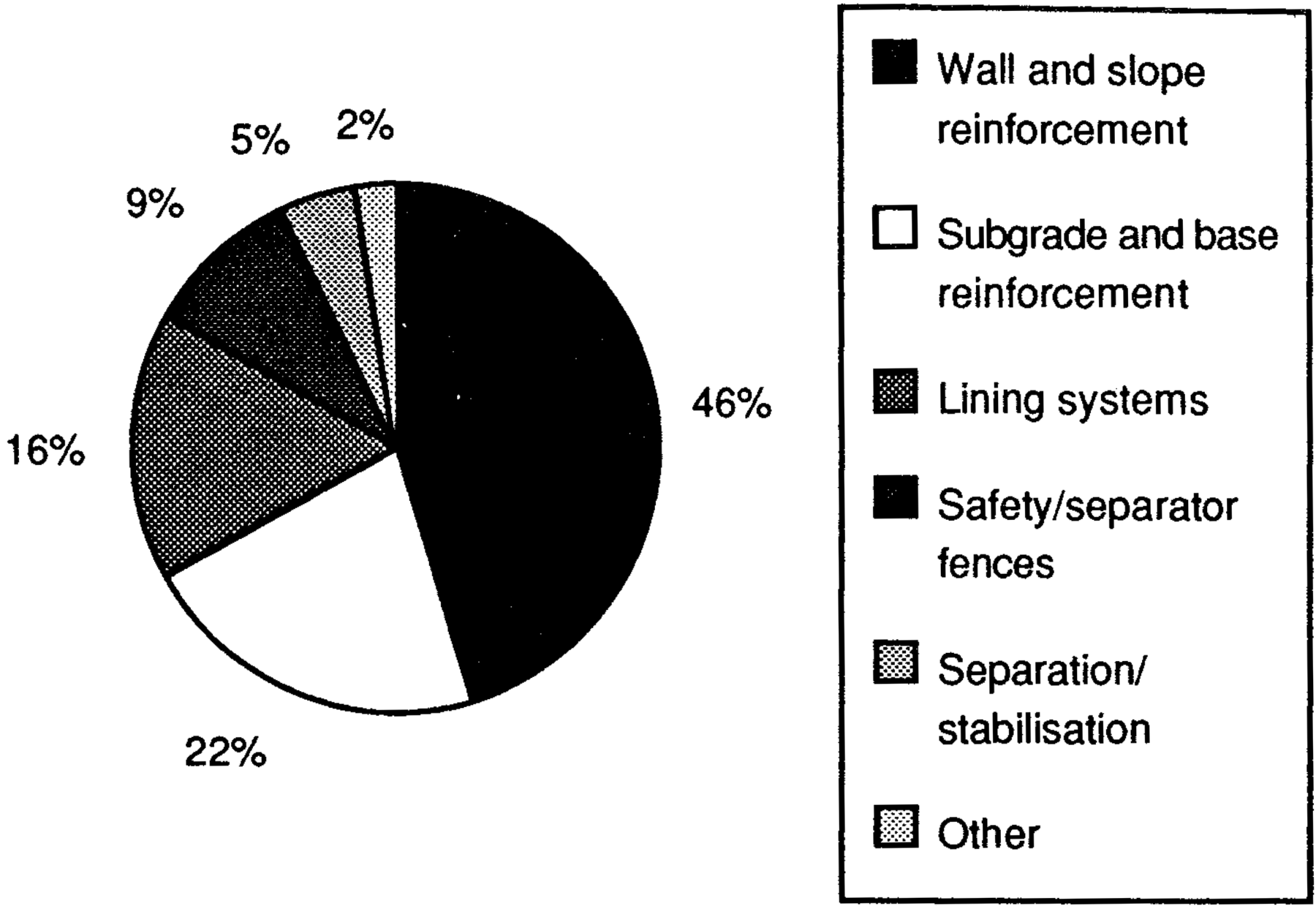
Geogrids are either made of drawn and punched sheets of high density polyethylene (HDPE) or polypropylene (PP) or high tenacity polyester (PET) fibres, usually coated in PVC or PE and bundled together to form a large open grid. The geogrid market has grown more than the overall geosynthetic market. This is mainly due to their suitability for slope remediation and wall reinforcement (see Fig. 2). The appearance of a variety of segmental wall systems incorporating geogrids will enhance their use. The “Design Manual for Segmental Retaining Walls” produced by the National Masonry Association (1992) in the U.S. is a timely publication and was quickly taken on board by the Concrete Masonry Association of Australia.
Geotextile Reinforced Seals for Clay Pavements
The Roads and Traffic Authority of N.S.W. has experimented with geotextile reinforced bituminous seals since 1985. They are intended to provide low-cost all-weather pavements for remote rural communities. The RTA (1992) has now issued guidelines which detail design and construction and give advice in respect to maintenance and construction.
After preparing the clay subgrade by compaction and a light spray with water, a tack coat is applied. The geotextile, usually a lightweight non-woven is then placed on the tack coat. This is usually followed by a cover ofsmall aggregate (5 to 7 mm) and rolling by a rubber tired roller until the bitumen becomes visible through the fabric. This is followed by a coarse aggregate seal (10 mm or 14 mm).
Considerable cost savings can be achieved using this technique compared with more conventional pavements of similar performance.
Drainage Composites
Geocomposite drains usually consist of a waffle type core surrounded by a filter fabric. They may be used in strip form as vertical drains, highway edge drains, conduits for leachate collection or gas venting. A multitude of other applications are possible, not only in geotechnical engineering, but also in agriculture, horticulture, landscape architecture and more. Geocomposite sheet drains may be used behind retaining structures and culverts in order to reduce pore water pressures. Australia has produced significant pioneering work in this area, e.g. in the design of high flow capacity drainage cells and the technology of extruding core material for composite drains.
Concluding Remarks
The geosynthetic market as well as its product range continue to expand, albeit somewhat slower than in the 1980’s. As environmental concerns grow, increasing demand for geosynthetic lining systems and erosion control products will arise. More geogrids are likely to be used in combination with low rise segmental wall systems.
By concentrating on geosynthetic functions, design procedures as well as the standard of specifications are continually improving.
Further research is needed in order to establish more reliable methods of predicting soil-reinforcement interaction, filtration performance and durability of geosynthetics. Field performance evaluation is essential to make further progress.
As geotextiles and other geosynthetics are becoming more common construction materials there is a danger that engineers treat them as commodity items disregarding the wide variety of products involved and the correspondingly wide range of possible performance levels.
References
Anonymous. “Utilisation of wool for black soil country roads”. Main Roads, February, 1933, Vol.IV, No.6, pp 84-85.
Barker, P.R. “Geotextile-reinforced vegetated barriers”. Geotechnical Fabrics Report, October 1991, pp 16-21.
Design Manual for Segmental Wall Systems. National Concrete Masonry Association (U.S.), 1992.
Finn, N.B., and Sadlier, M.A. “A study of geotextile use in Australia”. Third Int. Conf. on Geotextiles, Vienna, 1977, pp 833-838.
Geotechnical Fabrics Report. A journal published by the Industrial Fabrics Association International, 345 Cedar St., Suite 800, St.Paul, MN 55101-1088, U.S.A.
Giroud, J.-P. “From geotextiles to geosynthetics: A revolution in geotechnical engineering”. Third Int. Conf. on Geotextiles, Vienna, 1977, pp 1-18.
Giroud, J.-P., and Perfetti, J. “Classification des textiles et me sure de leur proprietes en vue de leur utilisation en geotechnique”. Int. Conf. on the Use of Fabrics in Geoechnics, Paris, 1977, Vol.2, pp 345-352.
Guide to Geotextiles. Austroads (P.O. Box 659m Haymarket, N.S.W. 2000, Australia), Technical Report, January 1990.
Guide to the Design. Construction. Maintenance and Management of Clay Pavements with Geotextile Reinforced Seals. Roads and Traffic Authority of New South Wales, 1992.
Hausmann, M.R, and Vagneron, J.M. “Analysis of soil-fabric interaction”. Int. Conf. on the Use of Fabrics in Geoechnics, Paris, 1977, Vol.3, pp 139-144.
Industrial Fabrics Association International (lFAI) , 345 Cedar St., Suite 800, St.Paul, MN 55101-1088, U.S.A.
Ingles, O.G. “The permeability of geotechnical fabrics, its reduction, and modification to suit particular uses”. Int. Conf. on the Use of Fabrics in Geoechnics, Paris, 1977, Vol.2, pp 323-327.
Ingles, O.G., and Lawson, C.R “MESL – A new appraisal”, 9th Int. Conf. on Soil Mechanics and Foundation Engineering, Tokyo, 1977.
Ingles, O.G., and Metcalf. J.B. Soil Stabilisation. Butterworths, Sydney, 1972.
Koerner, R.M., Hsuan Yick, and Lord A.E. “The 1992 Mercer Lecture – Remaining technical barriers to obtain general acceptance of geosynthetics”. Conf. on Grouting. Soil Improvement and Geosynthetics, ASCE Geotechnical Special Publication No.30, 1992, pp 63-109.
Koerner, RM. Designing with Geosynthetics. Second Edition, Prentice-Hall, 1990.
Parker, RJ., and Sadlier, M.A. “Geomembrane applications in Australia”. Geosynthetics ’91 Conference, Atlanta, Georgia, pp 77-86.
Sotir, RB., and Gray, D.H. “Fill slope repair using soil bioengineering systems”. Public Works, 1989, 120 (13), 37-40.
Talevski, P. Engineering aspects of membranes. University of Technology final year project. Unpublished, 1990.
Theisen, M.S. “Geosynthetics in erosion and sediment control”. Geotechnical Fabrics Report, May/June 1992, pp 26-35.
Yamanouchi, T. “Experimental study on the improvement of the bearing capacity of soft ground by laying a resinous net”. CSIRO Symp. on Foundations on Interbedded Sands, Perth, 1970.
Appendix
- AS 3706.0-1990 Geotextiles – Methods of test: General introduction and list of methods
- AS 3706.1-1990 Geotextiles – Methods of test: General requirements, sampling, conditioning and basic physical properties, and statistical analysis
- AS 3706.2-1990 Geotextiles – Methods of test: Determination of tensile Properties – Wide-strip method
- AS 3706.3-1990 Geotextiles – Methods of test: Determination of tearing strength – Trapezoidal method
- AS 3706.4-1990 Geotextiles – Methods of test: Determination of burst strength – California bearing ratio (CBR) plunger method
- AS 3706.5-1990 Geotextiles – Methods of test: Determination of puncture-resistance – Drop cone method
- AS 3706.6-1990 Geotextiles – Methods of test: Determination of seam strength
- AS 3706.7-1990 Geotextiles – Methods of test: Determination of pore-size distribution – Dry-sieving method
- AS 3706.9-1990 Geotextiles – Methods of test: Determination of permittivity
- AS 3706.10-1990 Geotextiles – Methods of test: Determination of transmissivity – Radial method
- AS 3706.11-1990 Geotextiles – Methods of test: etermination of durability – Resistance to degradation by light and heat
- AS 3706.12 -1990 Geotextiles – Methods of test: etermination of durability – Resistance to degradation by hydrocarbons or chemical reagents
- AS 3706.13 -1990 Geotextiles – Methods of test: etermination of durability – Resistance to degradation by certain microbiological agents