Geocomposites for batter stabilisation Yallourn open cut brown coal mine
Project Description
The Yallourn Open Cut brown coal mine is located at the western edge of the vast Latrobe Valley coal measures (Figure 1). It supplies the 1,450 MW Yallourn W Power Station and the Morwell Briquette Factory with a total of 16M tonnes of coal per year.
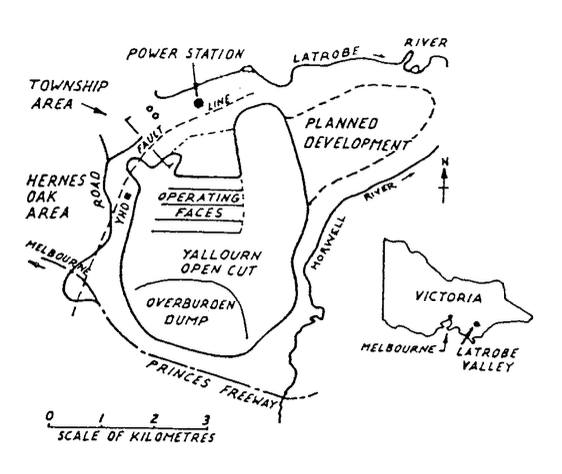
Fig 1: Yallourn Open Cut site location plan
Coal is currently being won in the Township Field where the permanent batter is being developed to within 50m of the Yallourn MonoclinelFault (YMF). Draping of the elastic sediments and coal seams across this structure have resulted in steeply dipping strata adjacent to, and dipping into, the open cut at angles of up to 40°.
The 2km long Township Field permanent batter system is being developed on the basis of maximisation of coal recovery and minimisation of batter stabilisation costs while maintaining the safety of the open cut operations (Pilkington et al – 1986, Jennings & Somerville – 1991). This is being achieved by:
- progressive removal of 7M m³ of de stabilising overburden from the top of the batter;
- construction of a 30m high stabilising surcharge embankment at the toe of the batter, and
- control of the groundwater levels in the permanent batter.
Project Objectives
The stability of the Township Field permanent batters is highly dependent upon controlling the groundwater levels within the coal batter. This is being achieved by:
- drainage of the No 3 coal cut face, buried by the surcharge embankment,
- drilling of sub-horizontal drains into the permanent coal batters, and
- establishment and maintenance of effective coal bench surface drainage.
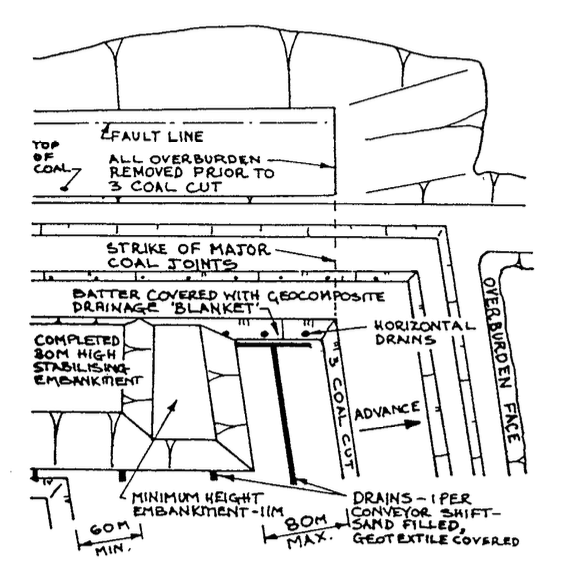
A diagram showing the layout of the drainage system is shown in Figure 2.
The groundwater within the permanent batter is contained within the vertical and sub-horizontal coal joints. These joints naturally drain where they daylight on the excavated batter face, however, burial of the coal face with overburden prevents this drainage. Modelling and observations in other parts of the open cut had indicated that groundwater levels would gradually build up within the batter and possibly lead to instability and failure of the batter.
To control the groundwater levels in the batter, a continuous geocomposite drainage layer is placed on the No 3 Cut coal face prior to placement of the stabilising embankment. This allows the continued drainage of groundwater from the coal face.
The seepage rate from the coal face was predicted at O.4m³/day per metre width using a computer seepage/ flow model. Flow of water from the drilled sub- horizontal drains was estimated at 0.05 l/sec each, based on observations of similar installations on the batters to the south of the current area of operations.
Geocomposite Material Selection
The geocomposite material chosen for use had to satisfy the following broad requirements:
- a minimum flow carrying capacity of 1.0 l/min per metre width under loads of up to 550 kPa,
- lined with geofabric on one side to prevent ingress of soil particles and clogging,
- sufficient flexibility to deform and take the shape of the uneven coal surface, and
- be able to withstand the UV exposure and other weather conditions during installation and prior to burial.
An extensive laboratory testing program (Kacavenda & Raisbeck – 1988, Kacavenda – 1992) resulted in selection of Drainmat SECV as the most suitable material. It consists of a highly permeable 2,000 g/m² polypropylene staple fibre core with 375 g/m² polyester staple fibre needle punched filter fabric bonded to one side. It is 20mm thick and laboratory load tests resulted in compression to 8mm under the maximum design load of 550 kPa.
Construction
To ensure minimal disruption to coal winning operations the following procedure was developed for installation of the No 3 coal cut drainage system:
- following excavation of the coal block immediately in front of the stabilising embankment, sub-horizontal drains 250m to 300m long, are drilled into the coal face;
- a drain is excavated in the coal at the toe of the batter and the sub-horizontal drains are fed down to the toe drain;
- the geocomposite roll is placed on stands at the top of the No 3 Cut batter and either pulled down the 23m high batter by hand or attached to a vehicle and pulled down so that it covers the toe drain;
- a collector drain is excavated from the toe drain to the top of No 4 Cut to drain water from the toe drain and to prevent the build up of excess water pressures at the base of the stabilising embankment;
- flexible, slotted pipes are placed in the toe and collector drains prior to backfilling with crushed rock or sand;
- the drains are covered with a geotextile to prevent the ingress of clay materials from the embankment, and
- the stabilising embankment is placed in 5m lifts to its full design height of 30m.
Drainage System Performance
A network of groundwater monitoring bores has been drilled in the permanent coal batter to monitor the effectiveness of the batter drainage system. Additional bores were drilled through the stabilising embankment to monitor the pore pressures in the embankment, the underlying coal strut and the interseam.
The monitoring bores indicate that there is no build up of groundwater pressures in the batter buried by the surcharge embankment. The unconfined groundwater and pore pressure levels in the batters are generally about 5m below the design levels required for stability. This indicates the drainage system has been effective in providing a pathway for the drainage of groundwater from the batter.
Conclusions
The geocomposite based drainage system used at the Yallourn Open Cut, for batter stabilisation is, maintaining the groundwater at or below the design levels. Geocomposite material Drainmat SECV is preventing the build up of water pressures behind the stabilising embankment.
References
Pilkington, T., Newcomb, S. and Lambert, A. (1986). Yallourn Open Cut, Stability of Permanent Batters, Yallourn Township Area, SECV Fuel Department Report No DD209, July 1986.
Jennings, A. and Somerville, J. (1991). Yallourn Open Cut, Township Field, Redesign of Permanent Western Batters, SECV Production Technology Report No. MGD10, August 1991.
Kacavenda, S. and Raisbeck, D. (1988). Yallourn Open Cut Western Batter Stability, Testing of Flow Rates in Geocomposites”, SECV Design Engineering & Environment Department Report GDD23, October 1988.
Kacavenda, S. (1992). Permanent Batter Stabilisation, Testing of Flow Rates in Geocomposites for new Three Year Contract, Geo-Eng PIL Report to Yallourn Open Cut No 200211, July 1992.