Exploration Magnetics – Theory and Practice
Book Review
Edited by: Phil Schmidt, James Austin, David Clark, Keith Leslie, Mark Lackie and Clive Foss
Review by:
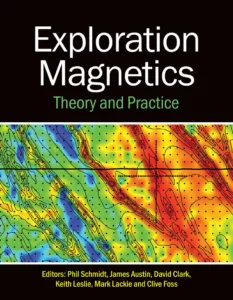
Exploration Magnetics: Theory and Practice is an excellent work in applied geophysics that consolidates decades of research, innovation, and case study analysis into a single, comprehensive volume. The latest edition, spearheaded by leading experts from CSIRO and collaborators across academia and industry, is timely and vital. In an era where subsurface discovery increasingly relies on remote sensing and inversion techniques, this book is a reference and a roadmap for geophysicists navigating the complexities of magnetisation in geological systems.
From the outset, the book distinguishes itself by placing the science of magnetic interpretation within a broader narrative of mineral discovery and economic importance. The Foreword and Preface sections are deeply informative and set a strong contextual foundation. They explain how Australia’s precompetitive geoscientific data infrastructure, especially the national magnetic data archive, has provided ground for developing and applying magnetic field inversion techniques. This geographic and scientific context is essential to understand the practical case studies woven throughout the book.
The first section of the book, covering the location of magnetisation by magnetic field inversion, does an exceptional job of revisiting fundamentals while pushing forward into new methodologies. Topics like gradient enhancements, survey planning, and data visualisation are addressed with clarity and depth. Chapter 2 is especially notable for its emphasis on real-world data optimisation, addressing the challenges geophysicists face in the field, from spacing and gridding to separating overlapping anomalies. Including a case study from Sedan, South Australia, grounds the theory in practical application.
The book’s nuanced discussion of sweet spots is a particularly commendable theme. Rather than overstating the certainty of magnetic inversions, the authors maintain a rigorous but realistic stance: inversion models are only as good as their assumptions and inputs. The book’s focus on deriving reliable key statistics from magnetic field data, rather than attempting to model every complexity in full detail, is both intellectually honest and practically invaluable.
Section 2 shifts to estimating magnetisation direction in a domain in which CSIRO and its collaborators have made foundational contributions. Chapter 5 stands out in the book as it addresses the crucial problem of recognising and quantifying remanent magnetisation, which is often ignored or oversimplified in conventional inversion workflows. The discussion of steeply plunging (“pipe”) magnetisations and remanent-induced complexities in Chapter 5.7 is exemplary, offering insights rarely available in other texts.
Chapters 6 through 11 extend this analysis to include the impact of source shape, plunge, compactness, and the use of UAV-acquired data. These sections are deeply technical. The case studies, including those near Jindabyne and Tenterfield, New South Wales, offer a balance of challenge and solution. Treating synthetic Martian terrain data as a training set (Section 11.4) is a creative and forward-thinking inclusion, showing the potential crossover of terrestrial techniques into planetary science.
One of the standout strengths of this edition is the clarity and consistency of the multi-author contributions. Despite its scope, the book reads with a unified voice, which is uncommon in many textbooks. Each chapter includes a clear abstract, structured subsections, and practical conclusions. The structure allows readers to easily navigate from theory to method to application, making it equally valuable as a textbook, reference guide, and field manual.
The final chapters (12–15) explore exceptional cases like magnetisation deficits, excavation anomalies, tripole/quadrupole modelling, and the development of the Australian Remanent Anomalies Database. These chapters, especially the database initiative in Chapter 15, underscore the importance of data curation and standardisation in supporting scientific progress. It is rare to see such a thoughtful compilation of legacy and newly acquired data.
The book emphasises the importance of combining inversion with geological understanding, highlighting the critical role of the geologist-geophysicist collaboration. The book is well laid out in terms of visual and structural design. The tables of contents are detailed and navigable, and the use of subheadings within chapters makes it easy to locate specific information. Though highly technical, the language is accessible, and explanations are well-supported with figures.
One minor production-related suggestion is to increase the width of figures to utilise page margins better, which would significantly enhance readability and visual clarity, particularly for complex diagrams and maps. While the current layout is clean, a more generous use of horizontal space would allow finer graphical details to be more easily interpreted, which is important for a subject like magnetic field inversion. This is more a note for the publisher than the authors and could further elevate the book’s practical value in future editions.
In summary, Exploration Magnetics is a triumph. It is an essential reference for applied geophysicists, exploration professionals, and researchers working on magnetic interpretation. It is also a valuable resource for advanced students in geoscience.
Gokul Venu Sreebindu
Publisher: CSIRO Publishing, Melbourne, Australia.
https://www.publish.csiro.au/book/8049
Format: Paperback, 320 pp
Pub date: 2 June 2025
ISBN: 9781486315574