A Symmetrical Tale
ABSTRACT
The Sydney Opera House Carpark is now 35 years old. This is part of the untold story, a significant milestone in Australian Geomechanics
1. INTRODUCTION
The Sydney Opera house is widely acknowledged as one of the world’s great buildings. Its beauty is correctly attributed to the Danish architect Jorn Utzon.
Many engineers, and a reasonable proportion of the Australian public, are aware that Utzon’s concept for the roof shells was a structural impossibility. It took the technical and persuasive skills of Ove Arup, and his senior engineers, Mike Lewis and Jack Zunz, to create a structurally sound rib system that substantially retained Utzon’s roof shapes.
The recent biography by Peter Jones sets out the story of this major contribution of Ove Arup to the structure of the Opera House. It also notes the pivotal role played by this famous project in the development of the Arup firm.
Buried within the biography is a gem of information, unknown to all those involved in subsequent developments at the Opera House site. This information adds a wonderful denouement to the association of Ove Arup with the building. This is the first telling of the full true story.
2. AN OPERA HOUSE WITH NOWHERE TO PARK
When the Opera House opened in 1973 for its first performance, Prokofiev’s War and Peace, there was no nearby place for parking. Patrons then, and two million annual patrons that followed over the next 20 years, had to walk from the train and ferry terminals at Circular Quay or find parking places in small business parking stations in the CBD.
Many schemes for parking stations to serve the Opera House were proposed as part of its original design, and over the following years. However, for financial and environmental reasons these came to nought.
3. THE CARPARK HAPPENS
After various false starts over more than 15 years, the New South Wales Government enacted the Bennelong Point Parking Station Act (1985) and put out a tender in early 1990 for private enterprise to build and operate a 900-vehicle underground car park to service the Opera House.
The Public Works Department provided a four-cavern reference design which had been developed by Arup and used as the basis of the Environmental Impact Statement by Planning Workshop in 1988. The facility was required to be built in a restricted footprint area beneath the Botanic Gardens, only a few hundred metres from the Opera House forecourt.
The Mulpha Group (Enacon Parking Pty Ltd) submitted a conforming tender that comprised two side-by-side rectangular caverns with cross connections at the ends. Each rectangular structure was much like a traditional aboveground parking station, with narrow ramps and tight corners. And if you were the last patron in either cavern you would have to wind your way down seven or eight levels and occupy the last place in the bottom corner.
The design had other unattractive features. Ventilation of the two chambers was difficult and expensive, and egress stairs knocked out a significant number of valuable parking spaces. It didn’t even fit into the allocated parcel of land. This was exacerbated when the Public Works Department asked during negotiations for an additional 200 spaces for Opera House employees to be accommodated in the car park. This was very costly and technically challenging.
Much to the surprise of most of the team members including the first two authors of this article, the Government accepted Mulpha’s submission. Basically, the competitors’ designs were much the same, and Mulpha had a better financial deal.
The preferred tenderer nomination was made in February 1990 on a Friday and most of the team members went home. In the days following, the Rankine & Hill team became concerned about the compromises evident in the reference and tender designs. These were drawn up and mapped out.
Messrs Barry, Colefax, Reid and Ferguson from Rankine & Hill met with architect Ron Barelle on the following Wednesday to discuss the issues of the cavern footprint, ventilation shafts, lost parking places to accommodate fire escapes, and having to drive down tight corners into the bowels of the earth to get to the last parking place.
Towards the end of the meeting Ron Barelle was sitting opposite Warwick Colefax, whose hands were clasped around a beer can. Ron said he had seen an aboveground parking station in Paris that was a helix, and it self-ventilated up through the spiral. Being an engineer who had learned to be patient with architects, Warwick pointed out that this would not work underground. But then, probably encouraged by the contents and shape of a beer can, the lights started going on and they started to sketch.
Within an hour they called Neil Fimeri, Mulpha’s Project Director. Tony Barry, Warwick Colefax and Ron Barrelle, met in the Union Hotel that Wednesday evening and continued their discussions of issues with the tender design.
They described the potential for an annular cavern footprint with a double helix spiral carpark to solve most of the issues. Neil authorised them to immediately work up an alternate design.
The Rankine & Hill team developed the initial concept of a 30m deep cavern, circular in plan with a central rock pillar, and this donut shaped cavern contained a double helix concrete structure that could be interconnected at any location simply by tunnelling horizontally through the central pillar of rock. Meetings with the architect and all engineering disciplines were scheduled for Thursday to make sure all the needs of various disciplines could be accommodated.
The gently sloping ramps of the helix provided for parking and access. Now the last parking place was not at the bottom, but at the top. Ventilation was easy with plant at the top level and vertical shafts around the circumference of the inner and outer edges of the cavern; only one cavern. Travel distances were substantially reduced and hence the required number of fire stairs was also reduced. The total volume of excavation was reduced, and low and behold, it could be fitted within the originally allocated development boundaries. The footprint area was reduced from 7900 square metres to 3000 square metres. The concept drawings were developed by Friday evening and sent to Neil Fimeri and Philip Pells at Coffey and Partners.
A stringent condition of tender was that under no circumstances was the ground surface in the Botanic Gardens to be disturbed for any purpose, and so the key question became: Could such a cavern be built, with only 6m of rock cover?
On the following Monday the first author, who was then a Principal of Coffey and Partners, turned up at work, oblivious of Wednesday’s beer befuddled discussion, and the detailed work that followed over the weekend. Mid-morning a fax arrived followed by a phone call. Simple question: Could such a cavern be built? I had never seen anything like it. Nobody had, because it had never been done before.
If one is very fortunate then perhaps once in a lifetime one will see a concept or design of sheer brilliance. That’s what appeared that morning. Furthermore, the requirement for an 18m span cavern with only 6m of Hawkesbury Sandstone cover kicked in an idea I had been mulling over ever since Dick Bieniawski pointed me to a 1940’s paper by Evans on linear arches. After some calculations of the amount of rock reinforcement necessary to create the requisite linear arch, it was concluded that the cavern could be built with no disturbance of the ground surface. The internal concrete helix structure does not support the sidewalls or crown of the cavern.
The team met again on Tuesday to work through how to present this to the Public Works Department and in doing so realised that it would be possible with a small amount of additional excavation to deepen the cavern to 36 metres which would provide the additional 200 car spaces for Opera House employees, from the savings achieved with the circular cavern design. The Rankine & Hill team went to work amending their drawings and Ron Barelle begun preparing architectural drawings for presentation to the government. Neil approached Glenn Monckton, the Public Works Department Project Director and with the team presented the alternate concept design. Soon after the team was invited to meet with Minister Wal Murray on the following Monday morning at 6.30am.
Over the weekend, architectural and engineering concept drawings were finalised with a small cardboard model of the double helix car park, with cross tunnels and car park markings and fire stairs to assist the team to understand how it would work.
By the Wednesday of that week the NSW Government agreed that the drawings upon which they had awarded the project could be thrown away, and the double helix was adopted. Enacon was given 60 days to lodge a development application for the alternate design.
However, in the background there was a problem. As indicated in Figure 1, the ground surface slopes gently down towards Sydney Harbour. With the proposed design, drivers on the exit (upwards) spiral were moving clockwise; and with the exit tunnel level being constrained by the Sydney Harbour Tunnel, I, the first author, concluded there simply was not sufficient rock cover on the harbour-side of the tunnel. Reluctantly I communicated this to Tony Barry, the second author. There was silence on the phone for a short while, and then he said. “No problem, we will just reverse the direction of the spirals”. That gave enough rock cover and that is why drivers exiting the carpark are travelling anticlockwise.
Three years later, on 17th March 1993, the facility was opened. It works brilliantly, even if some patrons get confused by the double helix.
Figure 1 is the original artist’s sketch of the underground facility. Figure 2 shows how it fits in plan.
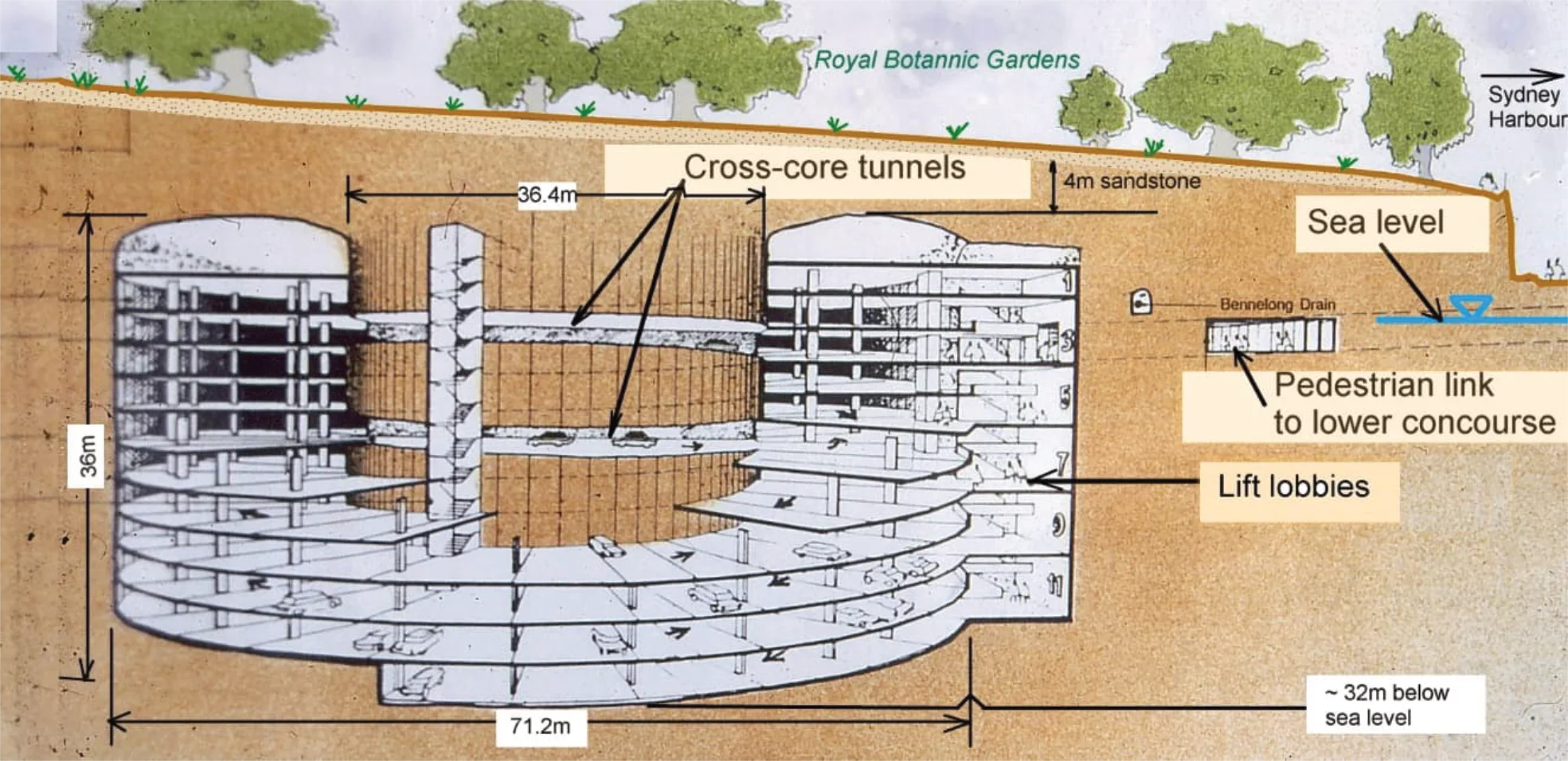
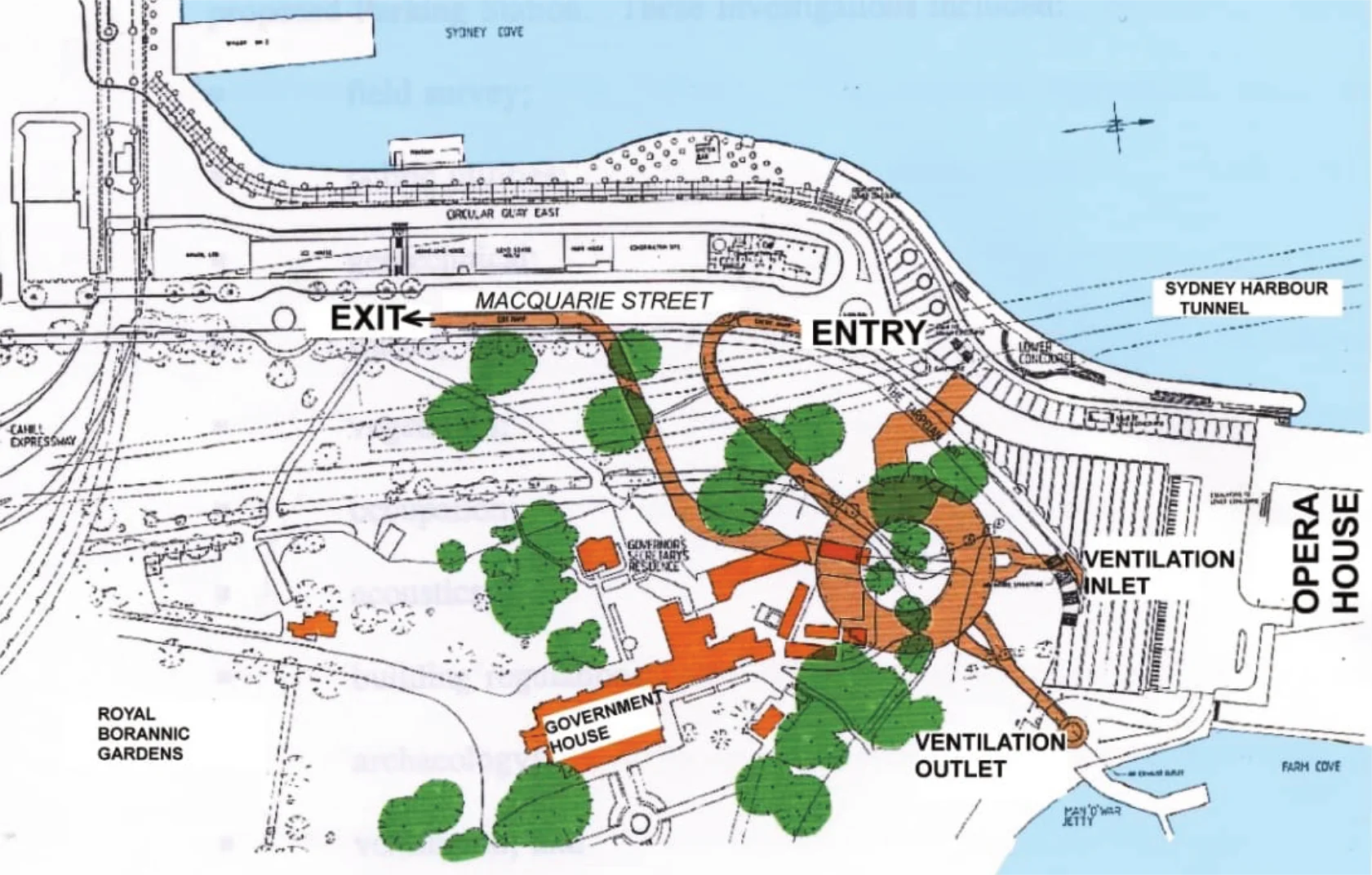
The carpark comprises a freestanding 12-storey double helix structure within the 140,000 cubic meter cavern. The cavern is about 60 meters from the shoreline of Sydney Harbour, and the floor is about 34 metres below sea level.
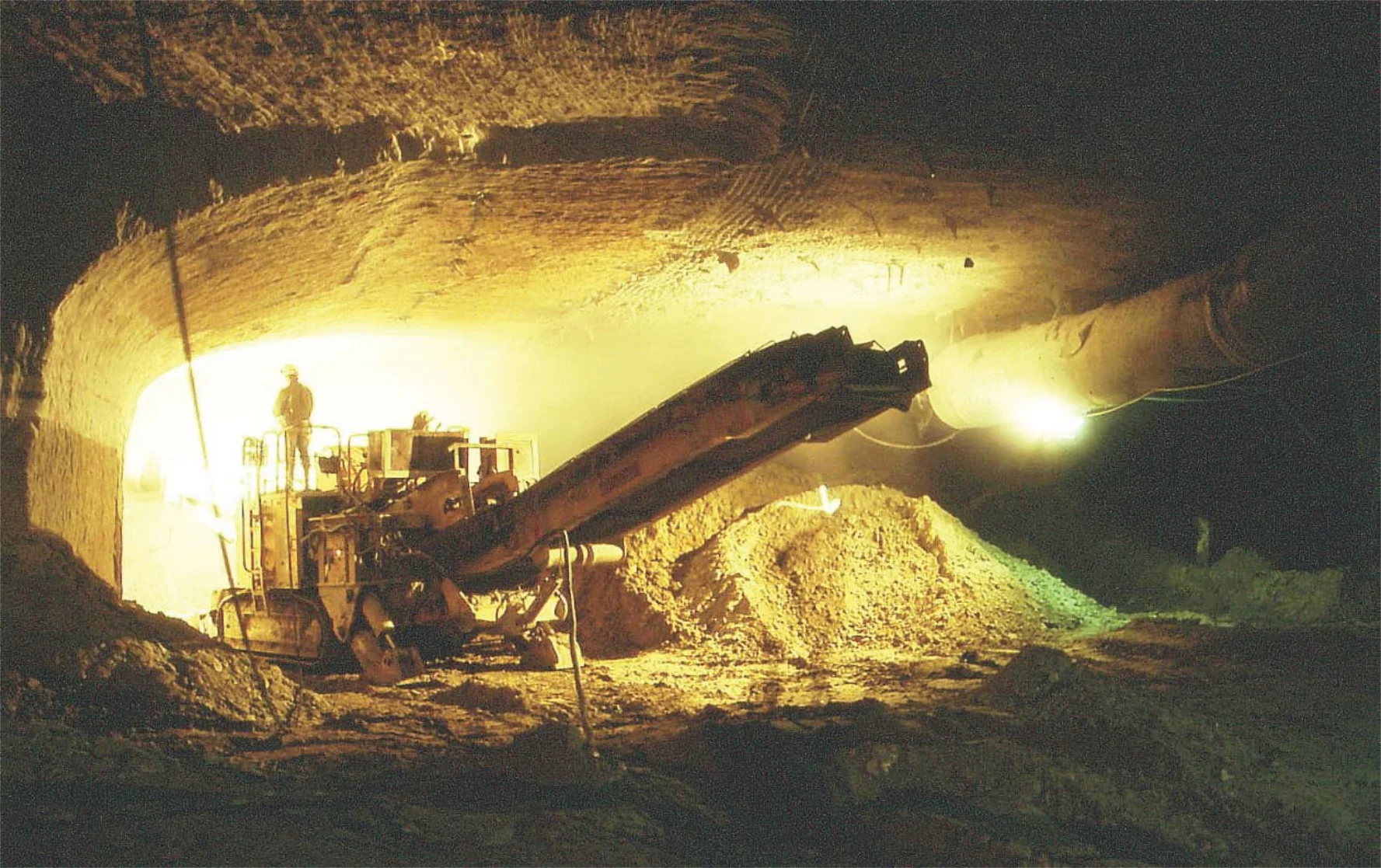
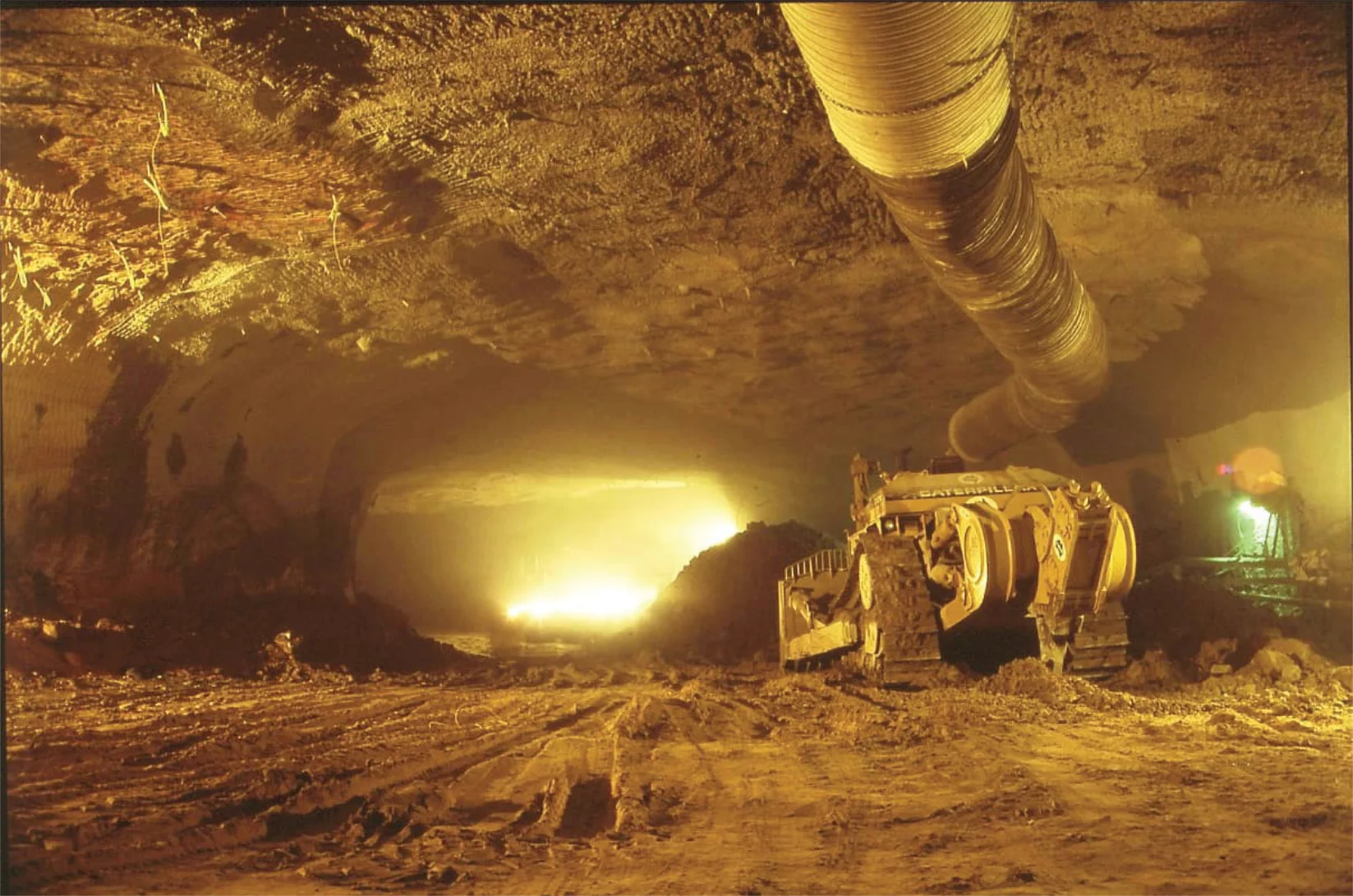
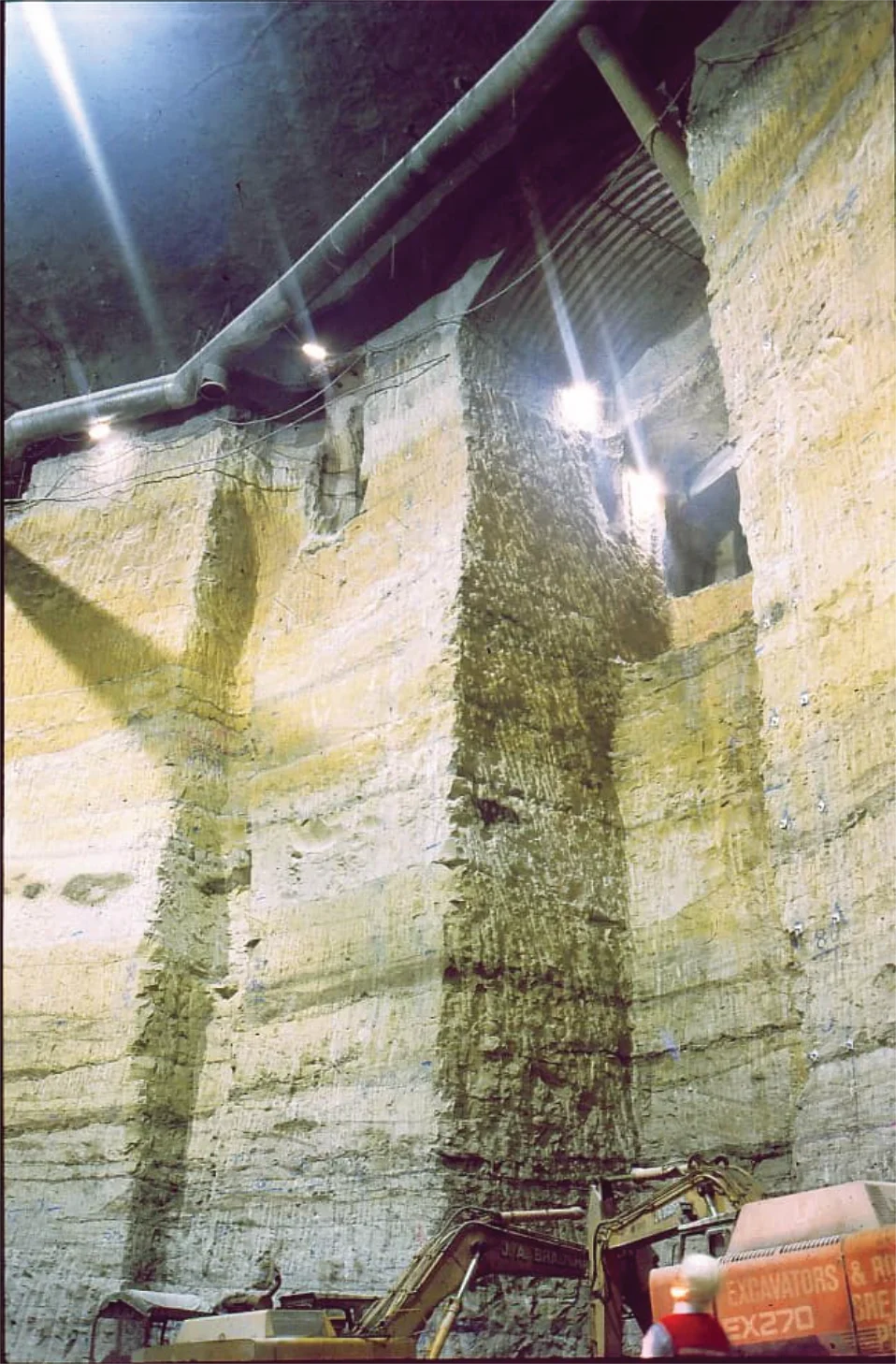
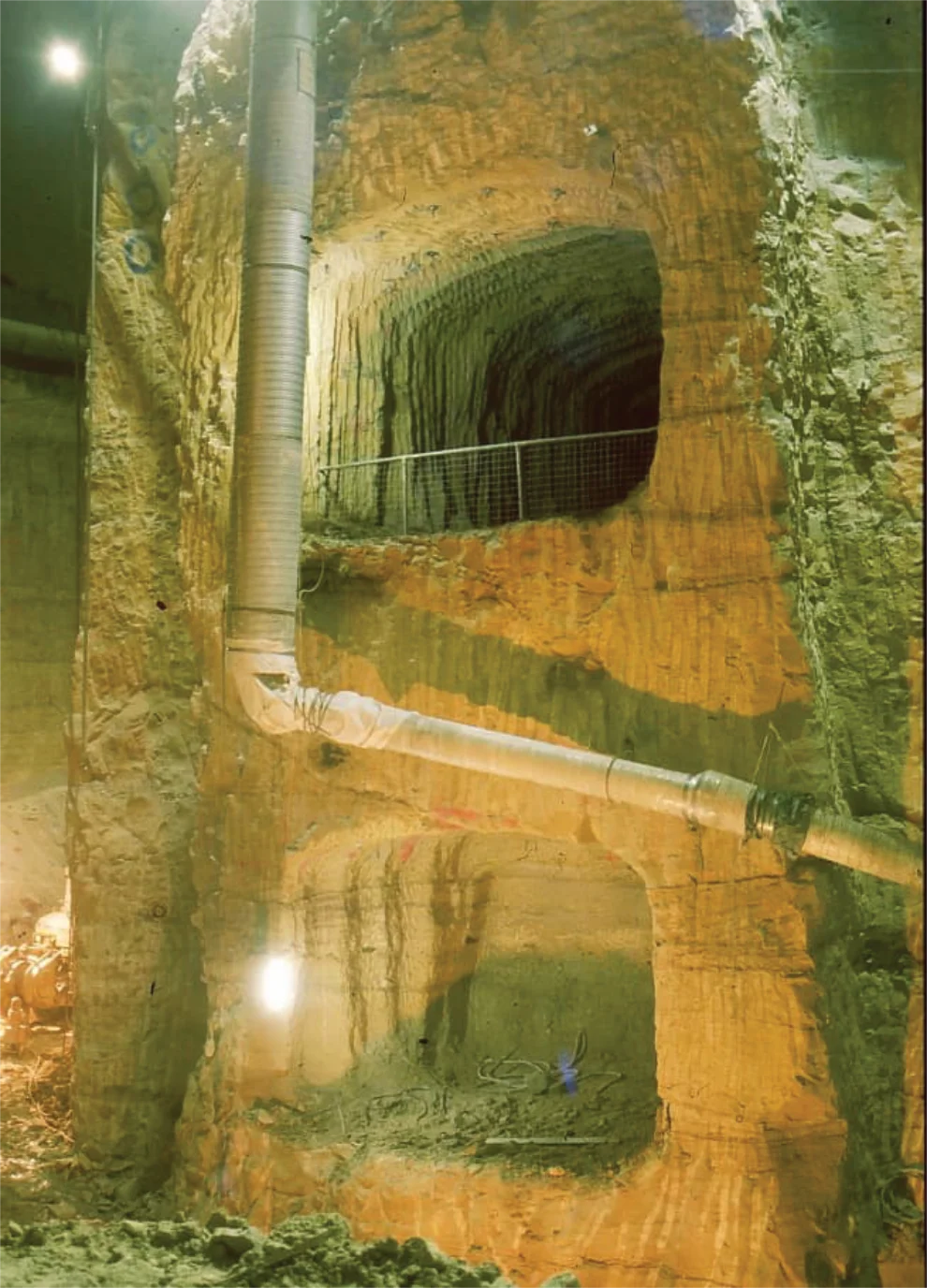
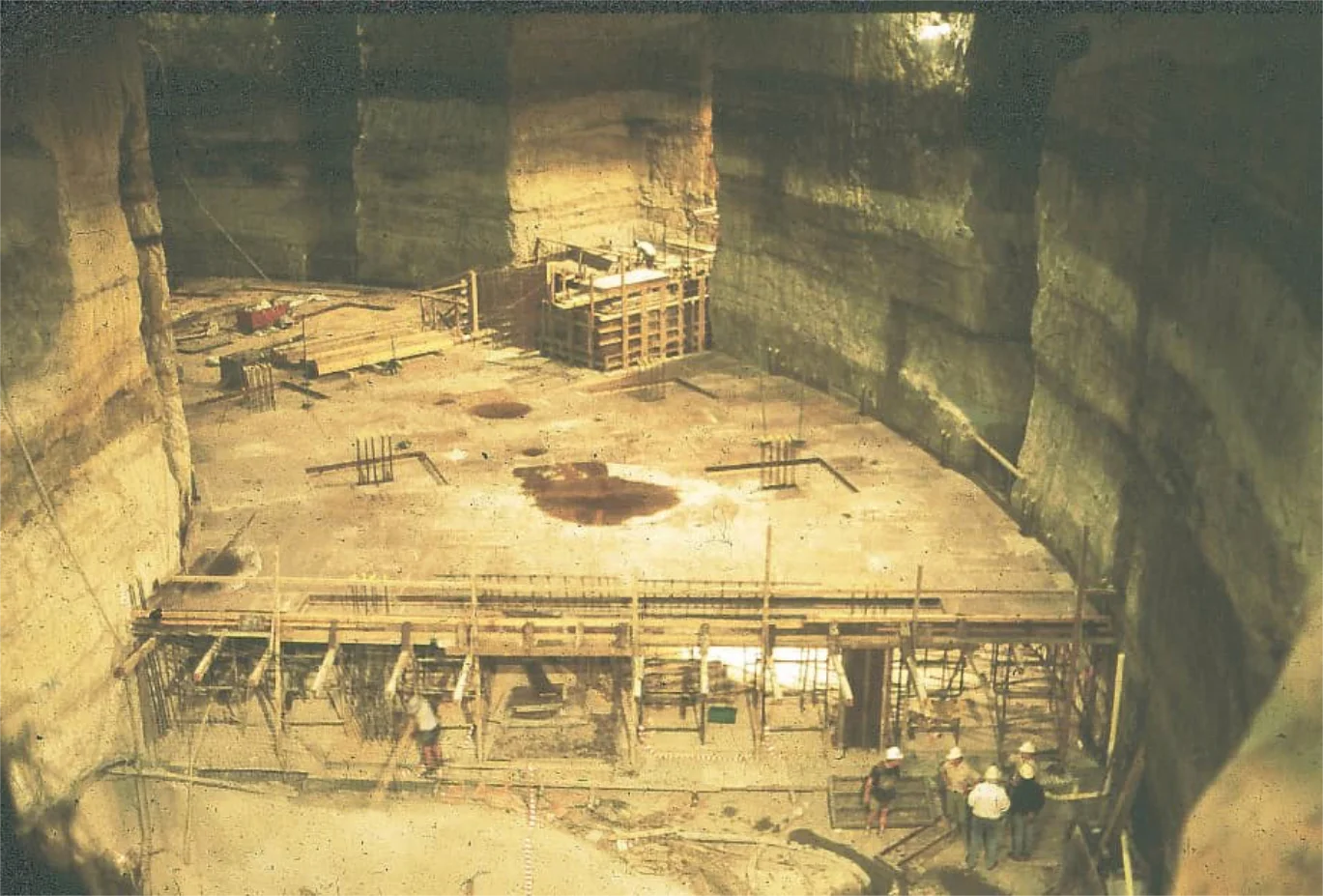
Figures 3 to 7 show parts of the cavern, during construction; the whole of which defied photography.
4. WHO FIRST THOUGHT OF A DOUBLE HELIX CARPARK?
Fascinated by the elegance of the double helix design, I, the first author, spent quite some time trying to find out who first thought of using a double helix in a building of any sort. This quest took me to fascinating places, from Chambord Castle on the Loire, a Leonardo da Vinci double helix staircase, to the double helix well in Orvieto, (the Il Pozzo della Rocca di San Patrizio), and to thought meetings with amazing people, from Archimedes to the Iranian architect of the Minaret of Jam in Afghanistan. But throughout this process I, like all others, involved in the project, had no doubt that the Sydney Opera House facility was the first time a double helix structure had been designed for an underground car park.
It was with this certainty that in March 2007, on a visit to my son Steven Pells in Cairns, I removed the plastic wrapper from the Peter Jones biography of Ove Arup that had been given to all staff members of Arups, all 5500 of them. In the steamy heat of Cairns, I browsed vaguely through the section describing Ove Arup’s involvement in the Opera House and then couldn’t believe my eyes when I saw Photograph No 32, reproduced herein as Figure 8. What it showed was that in 1938, as part of designing air raid shelters for London, Ove Arup had designed an underground helical structure that was intended to, after hostilities, act as a car park. Well, I thought, at least he didn’t think of a double helix. But I had only to turn to page 74 to find out that I was wrong. As Peter Jones says: “In his March version, Ove designed ramps in the form of two helixes, one inside the other, echoing his design of the penguin pool at London Zoo.” Unfortunately, we have been unable to locate the drawings of the double helix version, but we accept Peter Jones’ statement.
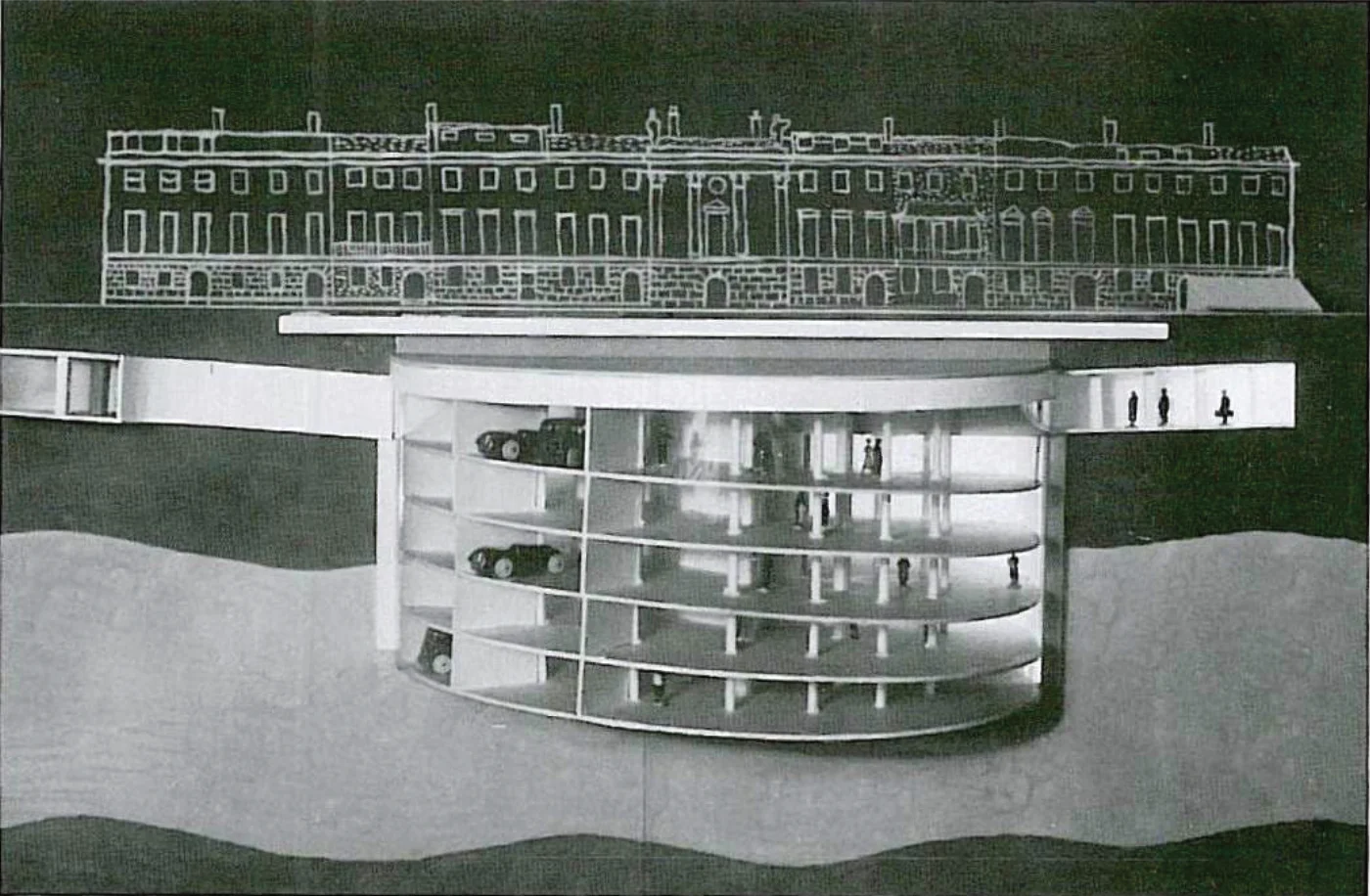
So, incredible as it seems, the double helix structure of the car park of the Sydney Opera House, was created unknowingly by Messrs Colefax, Barry and Barrelle to almost exactly mimic a 55-year-old, never-built, Ove Arup design. We can only wonder:
- “Would Ove Arup, personally, have come up with the double helix design for the car park if he had been retained by one of the groups that submitted turnkey designs in response to the NSW Government tender of 1990?”
5. DENOUMENT
Tony Barry’s little story
In February 1993, Tony documented the development of the Opera House Car Park for his Master of Engineering Science thesis “The Bennelong Point Parking Station”.
The late, and great, Professor John Booker at Sydney University reviewed the document and asked if Tony wanted it considered for a PhD given the substantial nature of the work; he agreed.
Some months later Tony was called in to meet John, who indicated the thesis had been sent to five examiners, four of whom agreed to consider it worthy of a PhD but one, from Arup, in London had suggested the idea was not innovative as Ove Arup had used it in the design of air raid shelters in 1938.
Tony was awarded his Master of Engineering Science Degree.
The heroes from the rock mechanics viewpoint
Turning the concept of a linear arch, only 4m to 6m thick, into reality was the result of exceptional work.
Firstly, Prof Harry Poulos turned his knowledge of laterally loaded piles upside down and at a considerably reduced diameter, to model the resistance of fully bonded rockbolts under bedding plane shear. Then Prof John Booker conjured up the mathematics of a linear arch as a 1-dimensional finite element system and scribbled the equations on a piece of paper. And then Ross Best took John’s equations and coded them for the minicomputer at Coffey’s North Ryde office.
Then Prof Ted Brown, as external reviewer, added long shear reinforcement anchors at the haunches.
This work was documented in 1990, before the cavern was excavated (Pells , Poulos, Best, 1990).
Authors; 35 years ago
Neil Fimeri was the Project Director for Mulpha Australia and was the man who made it all happen, from concept, through design, on to construction and then operation as a car park. Being Neil, he has now morphed into a mechanical engineer manufacturing large scale air-conditioning facilities.
Tony Barry was with Rankine and Hill and together with Warwick Colefax and others took a mad design concept and made it work. He went on to be CEO of Aurecon and along the way was awarded an AM.
Philip Pells was a Director of the then private company Coffey & Partners. He was given the flick pass of designing and implementing the rock reinforcement system for what might be still the widest low cover rock cavern in the world; although years later having visited the extraordinary 2000-year-old caverns at Longyou in China maybe they take the crown. He went on the help establish the firm Pells Sullivan Meynink, now known just as PSM
CRediT authorship contribution statement
Philip Pells: Writing – original draft. Tony Barry: Writing – review and editing. Neil Fimeri: Writing – review and editing.
5 REFERENCES
Jones, P. H. (2006). Ove Arup: Masterbuilder of the Twentieth Century. Yale University Press.
Pells, P.J.N., Poulos, H.G. and Best R.J. (1990). Rock reinforcement design for a shallow large-span cavern. Proc, 7th Int. Conf. Rock Mechanics, Aachen.