Victoria PhD Research Award 2026
Fatemeh Safari Honar, Sadib Bin Kabir and Pramod Dilshan Ranathunga Arachchige Don
The AGS Victoria PhD Research Award is presented by the Victoria Chapter of the Australian Geomechanics Society (AGS) as part of its ongoing commitment to support academic institutions and researchers, and to foster collaboration between academia and industry. This award provides a platform for PhD researchers to showcase their research to the geotechnical community. The award is presented biennially, following its successful introduction in 2022.
The Award
The winner will receive:
- a token of appreciation; and
- cash prize of $1,500 from the Australian Geomechanics Society.
Selection Process
Applications will be required to submit an abstract for review. Shortlisted candidates will be selected and required to prepare a 2000-word technical note for publication in the Australian Geomechanics journal and make a 20 minute presentation at a meeting of the Victorian Chapter of the Australian Geomechanics Society. A judging panel will evaluate abstracts and review technical notes and presentations. The winner will be announced at the conclusion of the meeting and in Australian Geomechanics at the time of publication. Candidates will be assessed based on the following criteria with equal weighting given to paper and presentation:
- Scientific quality;
- Originality;
- Innovation;
- Standard of presentation; and
- Practical significance.
About the presenters
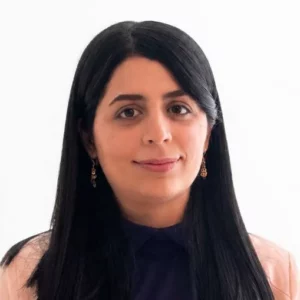
Fatemeh Safari Honar University of Melbourne
Soil–Pile Interaction in Guardrail Barriers: Soil Constitutive Modelling and Reliability-Based Optimisation
Roadside safety barrier performance is governed by complex nonlinear soil–pile interaction, which is highly dependent on variable soil conditions and post embedment depth. This study develops a new soil constitutive model for barrier applications, incorporating strain-rate dependency and strain softening to better represent soil response under impact loading. The model is implemented in LS-DYNA and used to generate finite-element simulations for W-beam guardrails. A metamodel-based reliability framework, integrated with Monte Carlo simulation and reliability-based design optimisation, is then applied to optimise post embedment depth for different soil conditions.
Biography
Fatemeh Safari Honar recently submitted her PhD at the University of Melbourne, where her research focused on soil–pile interaction in roadside safety barriers, soil constitutive modelling, and reliability-based design optimisation. She is currently working as a Geotechnical Engineer at Stantec, with interests in soil–structure interaction, geotechnical design, and numerical modelling.

Sadib Bin Kabir Monash University
Heat and mass transfer evaluation of geosynthetic-insulation cover for a pit thermal energy storage system
Pit Thermal Energy Storage (PTES) is a cost-effective seasonal storage technology supporting Australia’s net-zero transition. The floating cover of PTES is the most thermally critical and expensive component (40–60% of system cost) and the primary source of operational heat loss. This study presents a novel coupled heat- and mass-transfer framework for a PTES cover system tailored to Australian conditions, incorporating atmospheric drivers of heat losses and Stefan’s diffusion law for vapour transmission. When comparing a heat-transfer reference model against a coupled model with inappropriate drainage, the results show that the surface heat-transfer coefficient increases fivefold, highlighting the importance of drainage system design.
Biography
Sadib Bin Kabir received his Bachelor of Science (2020) and Master of Science (2022) degrees in Civil Engineering from Khulna University of Engineering and Technology (KUET) in Bangladesh. His PhD study at Monash University focuses on improving the performance of Australian solar-based pit thermal energy storage systems by evaluating geomembrane–insulation cover systems, with an emphasis on coupled heat and water-vapour transport, geomembrane durability, and the thermo-hydro behavior of surrounding soils. He has served as a Teaching Associate in the Department of Civil and Environmental Engineering (CEE) at Monash University since 2023, and previously worked as a Lecturer in Civil Engineering in Bangladesh. He is currently a PhD candidate under the supervision of Professor Abdelmalek Bouazza and also serves as the CEE postgraduate representative at Monash University. He has published numerous peer-reviewed journal and conference papers across geosynthetics, thermal energy storage, and renewables.

Pramod Dilshan Ranathunga Arachchige Don University of Melbourne
Geochemically Induced Alterations in Caprock: Implications for Safe Underground Hydrogen Storage in Depleted Gas Reservoirs.
Hydrogen is emerging as a promising energy carrier to store surplus renewable energy for later applications. In this context, underground hydrogen storage (UHS) in depleted gas reservoirs has become a preferred solution due to its large capacity and geological feasibility. These reservoirs comprise a low-permeability caprock that prevents hydrogen leakage into upper strata. However, prolonged exposure to microbial processes, including acetogenesis, may trigger acidified fluid-rock interactions, compromising caprock integrity. This research investigates the impacts of these interactions on caprock deformation. Preliminary findings indicate substantial carbonate dissolution, increased porosity, and reduced rock strength, thereby providing critical insights for safe UHS implementations.
Biography
Pramod Dilshan is a third-year PhD candidate in the Department of Infrastructure Engineering at the University of Melbourne, supervised by Dr Samintha Perera and Dr Saeed Salimzadeh. His research focuses on the integrity of shale caprock for underground hydrogen storage, employing advanced experimental techniques to investigate the mineralogical, microstructural, mechanical, and fracture behaviour of shale caprock under varying acidified fluid–rock interactions. In recognition of his contributions to the academic community, he was awarded the 2025 Graduate Research Student of the Year. Through his research, Pramod aims to advance the safe and reliable deployment of underground hydrogen storage technologies, supporting the global transition to a low-carbon energy future.
Engineers Australia members participating in AGS technical sessions can record attendance on their personal CPD logs. Members should refer to Engineers Australia CPD policy for details on CPD types, requirements and auditing guidelines.